
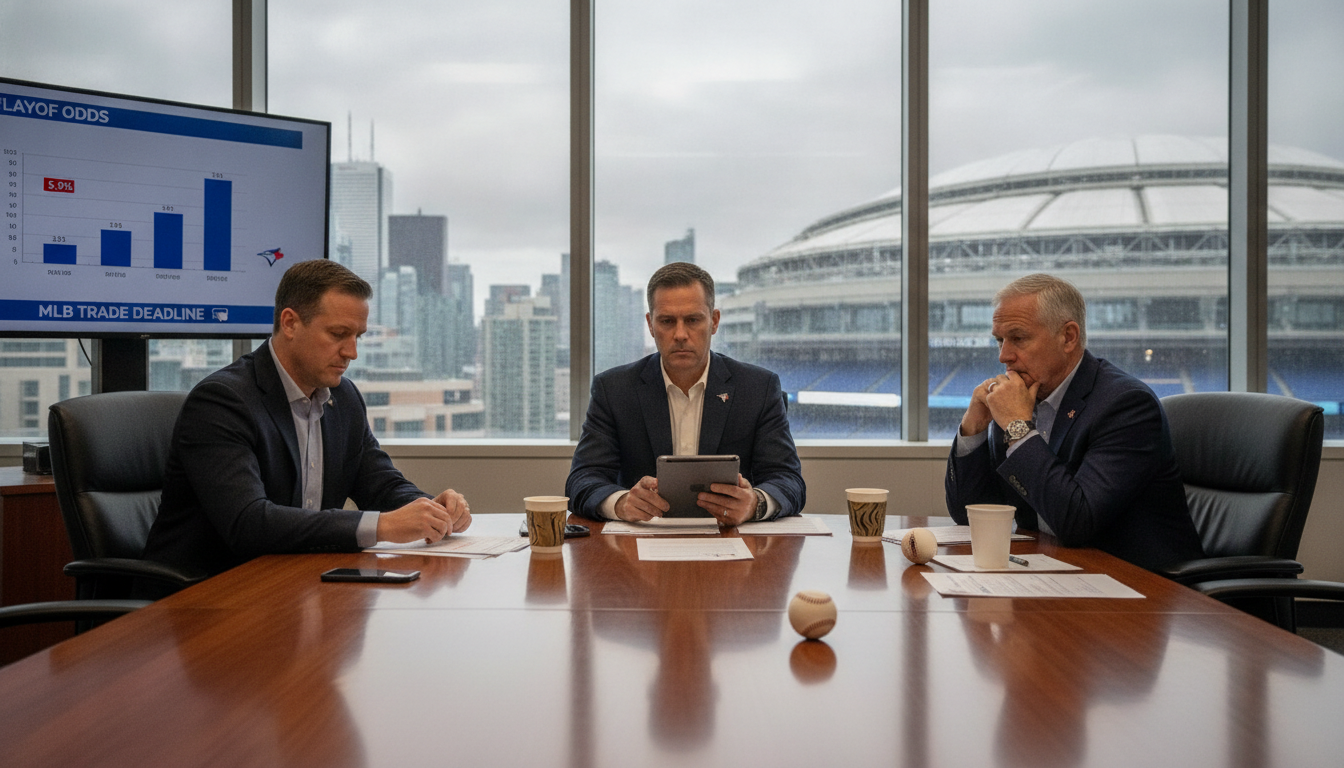
Blue Jays trade candidates take center stage as Toronto’s playoff chances slide
Blue Jays trade candidates are under the microscope after Toronto opened the second half poorly and now holds a 5.9% chance of reaching the postseason. The slump — including three consecutive series losses — has pushed the front office toward the kind of roster decisions that reshape a summer deadline. With General Manager Ross Atkins historically active in the 10-day run-up to the deadline, a busy week of trades appears likely.
Toronto’s second half slide and the urgency to act
The Blue Jays entered the second half with hopes of climbing back into contention but instead lost ground quickly, dropping three series in a row. That skid coincided with a sharp drop in playoff probability to a season-low 5.9%, increasing the incentive to evaluate sell-side moves. For a club with payroll commitments and a roster that still contains both rentals and controllable pieces, the coming days are likely to prioritize creating future flexibility.
Atkins’ deadline pattern points to multiple deals
Ross Atkins has completed at least three trades in the 10 days before the deadline during his decade as Blue Jays GM, a pattern that makes further activity probable this year. The organization has a mix of impending free agents, veterans with trade protections, and younger controllable players that complicate choices. While some short-term rentals will attract interest, the club also has several players — such as Louis Varland and Ernie Clement — who appear unlikely to be moved given their control and fit in a 2027 rebound plan.
Tier one rentals that could draw serious offers
Top-tier rental pieces on the market include starting pitcher Kevin Gausman and outfielder Daulton Varsho, both under contract through 2026. Gausman, a proven starter earning roughly $23 million this season, should generate interest from contenders seeking rotation help, though he carries specified trade restrictions that limit potential landing spots. Varsho, at about $10.75 million in 2026 compensation, has seen some defensive and sprint-speed decline but remains an intriguing outfield option for clubs that can use his bat and occasional outfield versatility.
Tier two free agents with trade complications
A second group of potential targets are pending free agents whose immediate value is clearer than their long-term fit. Shane Bieber has shown flashes of strong performance and will draw scouting inquiries despite a recent poor outing that raised questions about consistency. George Springer represents a more complicated case: his sizeable salary and 10-and-5 rights mean he would have to approve any trade, and his limited contemporary outfield work may narrow his market to teams needing a designated hitter or right-handed bench bat. Max Scherzer, meanwhile, remains a veteran starter who could be moved but likely will command limited return given age and recent results.
Controllable players who could net prospects
Beyond rentals and expiring deals, the Blue Jays possess controllable players who could fetch meaningful returns if the front office opts to sell. Jesus Sanchez, under club control through 2027, offers significant power and a strong split against right-handed pitching, making him a near-term platoon candidate and a likely conversation piece. Myles Straw brings speed and defensive value off the bench and carries a club option structure that complicates but does not eliminate trade interest. Jeff Hoffman, a late-inning arm capable of missing bats, presents upside for a team willing to absorb a higher reliever salary.
Injury status restricts some trade options
A pair of injured veterans reduce the pool of tradable assets in the near term. Patrick Corbin is sidelined with a teres major strain and is expected to miss multiple weeks, a timeline that diminishes his short-term marketability. Yimi Garcia experienced a setback while rehabbing an elbow injury, and that uncertainty makes teams hesitant to trade for immediate bullpen help. In both cases, the Blue Jays appear more likely to retain these players and evaluate post-recovery options than to move them now.
Low-likelihood moves and core pieces the club values
There are several players who, while available in theory, are unlikely to be traded given control, cost or role. Nathan Lukes provides defensive versatility with team control into 2030 and is not an obvious trade chip. Tyler Rogers has two years remaining on his deal and would improve many bullpens, but that term may limit rival willingness to make a compelling offer. Louis Varland stands out among controllable relievers as a core piece the club would only consider moving for an overwhelming return, making his departure a major surprise.
As the deadline approaches, the Blue Jays trade candidates list will be parsed by contenders and rebuilders alike, with each club weighing payroll, roster fit and prospect capital. Toronto’s front office must balance the short-term returns that rentals can bring against the long-term value of controllable players, all while navigating trade protections and injury timelines.
The coming days are likely to determine whether the Blue Jays pursue a slate of deadline departures to restock the farm system or retain depth pieces and continue to chase a late-season surge.
