
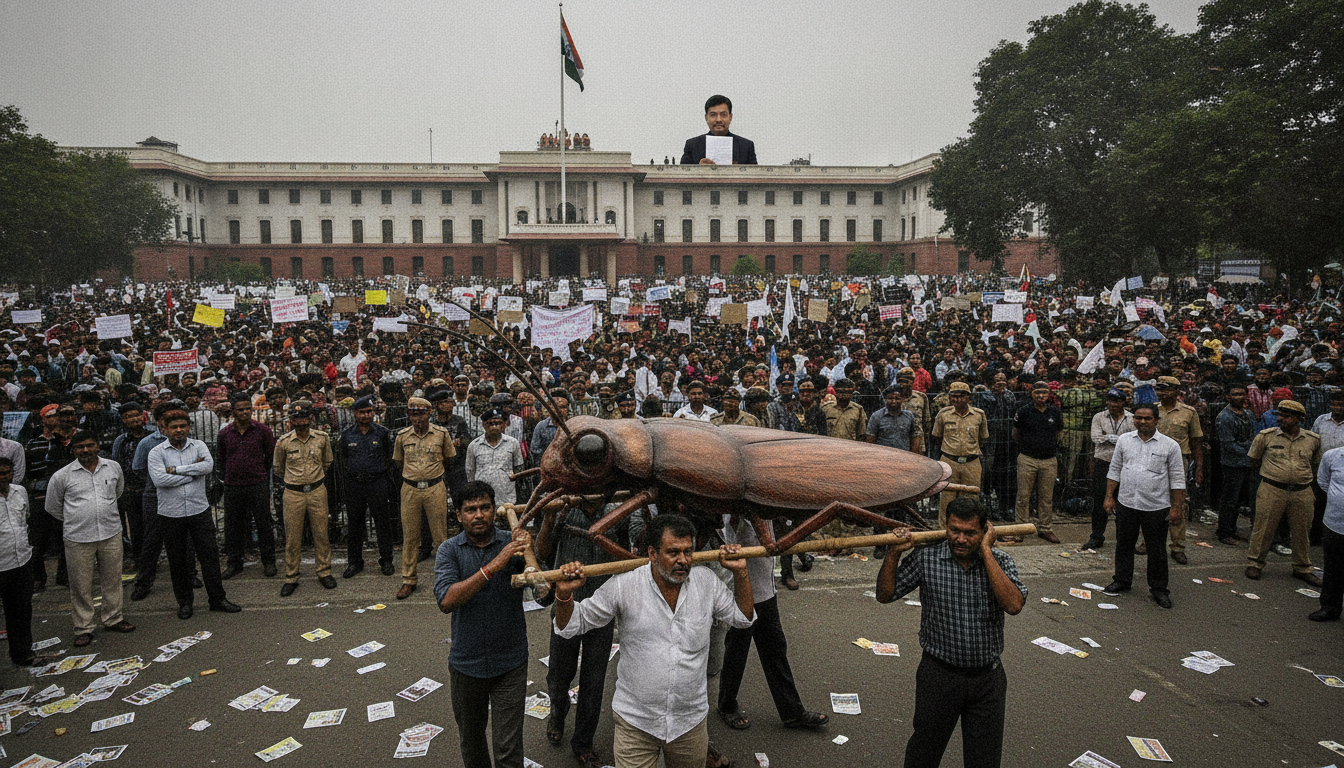
Cockroach Janta Party student protests force India’s education minister to quit
Cockroach Janta Party protests in New Delhi forced the education minister to quit and won commitments on exam reforms, compensation and dropped cases.
Abhijeet Dipke’s Cockroach Janta Party movement announced a breakthrough after weeks of mass demonstrations in New Delhi, saying the government had acceded to core demands including the resignation of the education minister. The student-led campaign, which began as a viral social-media post, mobilized thousands at Jantar Mantar and framed its demands around exam integrity and accountability. Organizers said the pact includes compensation for affected families, withdrawal of police cases against protesters and a pledge to discuss broader exam reforms.
Education minister steps down after mass protests
The protests began after a high-profile exam leak that led to the cancellation of a major medical-college entrance test taken by 2.2 million candidates, triggering anger across India. Demonstrators argued that the leak exposed systemic failures in the national exam system and demanded political accountability, naming the education minister as responsible.
The resignation represents a rare public concession by Prime Minister Narendra Modi’s administration to a youth-led movement, and officials held multiple rounds of talks before the agreement was reached.
From a social post to a 22‑million‑follower movement
The Cockroach Janta Party was born from a single social-media question posted by Abhijeet Dipke after a senior official likened unemployed youth to “cockroaches.” Within days the post spread, and Dipke and collaborators used simple digital tools to create a platform that quickly attracted millions of followers.
Dipke, an international student who recently completed a master’s degree in public relations at Boston University, returned to India in early June to lead street protests. Organizers credit rapid online growth and youthful energy for converting online outrage into sustained on-the-ground action.
Sit-in at Jantar Mantar and disciplined nonviolence
Protesters established a prolonged sit-in beside the 18th-century Jantar Mantar observatory, where they camped for weeks and maintained a visible, organised presence. Demonstrators frequently invoked nonviolent figures such as Mahatma Gandhi and B.R. Ambedkar to underline the peaceful intent of their campaign.
Authorities maintained a heavy security presence and clashes occurred on at least one occasion when protesters attempted to march toward Parliament. Organizers and some witnesses disputed police accounts that described demonstrators as “unruly,” insisting the movement prioritised peaceful protest even as tensions rose.
Negotiations produce formal concessions from government
After escalating public scrutiny and several days of talks at a neutral venue, government ministers negotiated with a Cockroach delegation in three rounds of meetings. Senior ministers Jagat Prakash Nadda and Jitendra Singh participated in the discussions, which culminated in commitments on several specific demands.
The agreed measures include compensation for families of students who died by suicide in the wake of the exam scandal, the withdrawal of police cases lodged against protesters, and a government pledge to formally consider a five‑point charter addressing examination procedures and broader education reforms.
Student leaders and public reaction
The movement drew support from a wide cross-section of society, including established education activists such as Sonam Wangchuk, who staged a 26‑day hunger strike in solidarity with demonstrators. Crowds at Jantar Mantar celebrated visibly when news of the government concessions arrived, elevating Dipke’s profile as a central organizing figure.
Participants described a sense of collective vindication after weeks of uncertainty, with many young protesters saying they felt their frustrations had finally found a channel for meaningful pressure. Observers noted that the movement combined digital reach with street-level organisation in a way that amplified student voices nationally.
Leader’s position and questions about sustainability
Although Dipke has become a public symbol for the campaign, he has downplayed ambitions to become a conventional political leader and said he prefers to keep the focus on the movement. He also expressed personal concerns about his family’s wellbeing and his own health after returning from overseas, noting limited time spent at home and a recent bout of illness.
Organisers declared the protests suspended “in good faith” after the government’s commitments, but analysts warn that concrete legislative and administrative follow‑through will be the true test of whether the movement achieves lasting change. The terms agreed in talks require implementation and oversight to address long‑standing problems in exam administration.
The Cockroach Janta Party’s rapid rise from an online joke to a street movement underscores both the depth of frustration among India’s youth and the power of digital mobilisation to force political concessions. The coming weeks will determine whether the announced reforms translate into durable changes for students and whether the movement can maintain momentum while shifting from protest to policy engagement.
