
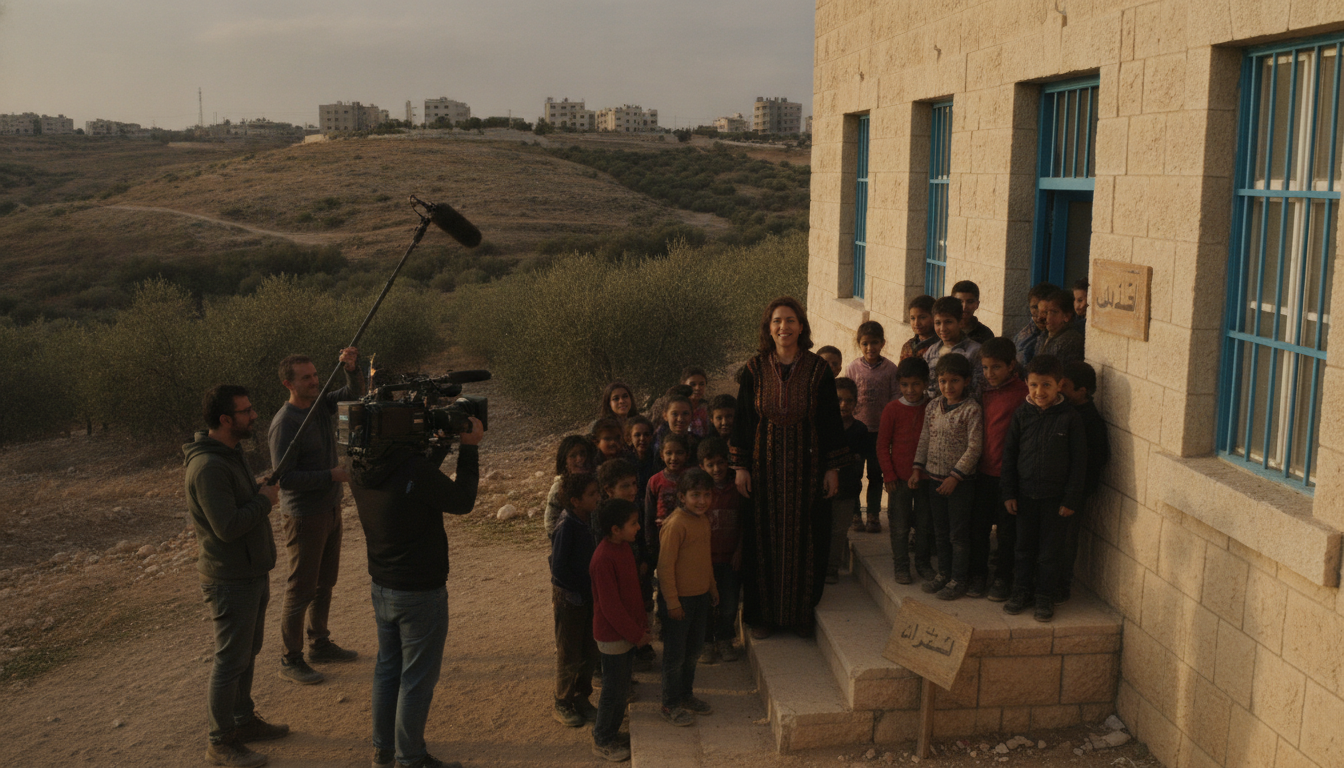
House of Hope documentary follows Palestinian teacher bringing Waldorf education to life under occupation
A new documentary, House of Hope, chronicles Manar Wahhab’s Waldorf school in the occupied West Bank and its struggle to protect children’s dignity under violence.
The House of Hope documentary follows Palestinian educator Manar Wahhab over three years as she runs a Waldorf-inspired kindergarten and elementary school in al-Eizariya, in the occupied West Bank. The film captures the school’s daily practices, the family life of Wahhab and her husband Milad Vosgueritchian, and the mounting pressures on the community after October 7, 2023. It won the best international feature documentary prize at Hot Docs in May 2026 and has since screened at UNESCO in Paris.
Intimate access across years
The director, Marjolein Busstra, traveled to the West Bank nine times and spent three years documenting Wahhab’s work and private life. Working with a Palestinian crew, Busstra sought sustained, embedded access so that the House of Hope documentary could show not only events but the emotional interior of teaching and parenting under occupation. The result is a portrait that alternates classroom moments with scenes of domestic strain, presenting Wahhab as both educator and parent.
Waldorf approach in a conflict zone
House of Hope Vision Kindergarten & School follows Waldorf pedagogical principles that emphasize creativity, emotional expression and nonviolent resistance. The school aims to shield children’s inner lives from the corrosive effects of chronic violence, offering structured play, drawing and storytelling as tools for coping. Wahhab and her husband founded the school to create a space of safety and dignity where children can develop agency despite external threats.
Filmmaking choices and ethical risks
Busstra intentionally filmed moments of vulnerability, including scenes where Wahhab breaks down in a classroom corner, explaining she wanted audiences to accompany the family through raw emotional states. Wahhab says their existing friendship and shared educational values fostered trust that allowed the crew to remain for those difficult scenes. The filmmakers faced ethical trade-offs in documenting pain while seeking to avoid exploitation, and they chose to keep the camera rolling to preserve the authenticity of those encounters.
Daily realities portrayed in the film
Scenes in the documentary show ordinary, anxious routines that have become normalized under occupation — parents checking chargers and spare clothes for children in case they are delayed at checkpoints, and children’s drawings that reflect trauma. Busstra says the school functions as a haven, but the occupation “is always rattling at the door,” a pressure that deepened after the events of October 7, 2023. Wahhab frames nonviolence as an intentional, courageous stance that requires inner work and patience rather than passivity.
Production context and past projects
The film was produced by Think-Film, noted for The Voice of Hind Rajab, which told the story of a young Gaza girl killed in 2024 and raised wider questions about the protection of children in conflict. Busstra first met Wahhab 18 years ago during a film workshop and returned to document the evolution of the school and family life across seasons. The production emphasizes local collaboration by hiring a Palestinian crew to record day-to-day life and community interactions.
Reception at festivals and upcoming screenings
House of Hope’s win at Hot Docs in May 2026 marked a significant recognition for a film rooted in intimate, local storytelling about the occupied West Bank. The documentary has since screened at UNESCO in Paris and is slated for the Jerusalem Arab Film Festival, signaling interest from both cultural institutions and regional audiences. Organizers and viewers have highlighted the film’s ability to shift focus from headline violence to the quieter work of education and care.
Reframing Palestinian narratives
Both Busstra and Wahhab say the film aims to complicate reductive portrayals of Palestinians by centering everyday humanity, creativity and parenting. Wahhab told the filmmakers she hoped to represent her community’s dignity and to counter stereotypes that reduce Palestinian lives to violence alone. The House of Hope documentary seeks to prompt viewers to consider shared human concerns—safety, childhood, and the ethical choices of educators—even in a setting marked by prolonged conflict.
House of Hope presents a close, personal view of how one school attempts to preserve childhood and cultivate resilience, asking audiences to consider the human costs of occupation and the quiet forms of resistance that take place inside classrooms.
