
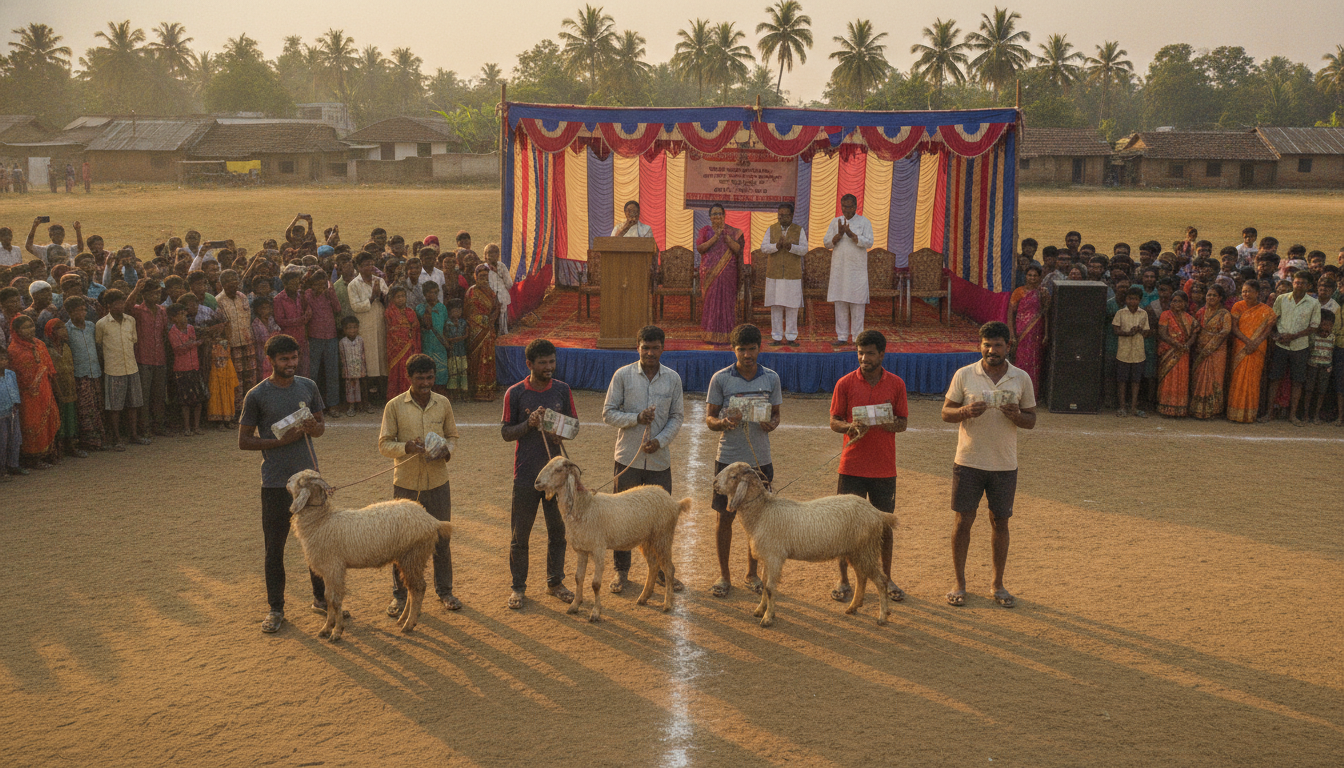
Khassi goats as trophies spotlight Ho community football festival in Chaibasa
In Chaibasa, Jharkhand, the Rangila Star Tirilbasa football tournament (July 14–17) awarded cash and khassi goats to winners, fusing Ho ritual with local sport.
The week-long event drew 64 teams from neighbouring villages to a village ground where winners received rupee prizes and live khassi goats as trophies. NCS Maudi won the final 1-0 over Kumbaram, taking home 15,000 rupees and three khassis, underscoring how sport and tradition intersect in this tribal district.
Local tournament awards khassi goats and cash
Prizes at the Rangila Star Tirilbasa combined modest cash payouts with live animals, a choice organisers say reflects community priorities. Runners-up and lower-placed teams also received rupees and khassis, while individual awards such as man of the match were cash-only.
NCS Maudi’s captain, Sachin Devam, said the team will transport the goats home after the victory and celebrate with the village. Organisers staged the finals with certified referees and invited commentators to keep play competitive and orderly.
Khassi goats embedded in Ho social life
For the Ho community, khassi goats are more than livestock; they are central to religious rites, feasts and communal sharing. Players and organisers described the khassi as a customary prize that guarantees a village-wide celebration when a team wins.
Young organiser Manish Kudada said many teams slaughter the animals for feasts while others keep them as trophies or breeding stock. Goalkeeper Raj Keshri stressed that celebrations without khassi meat would feel incomplete at local weddings and festivals.
Village-based rules and a modified game
The tournament follows adapted rules aimed at strengthening village identity and broadening participation. Teams field nine players rather than eleven, and at least six members must belong to the same village, a regulation organisers enforce to promote unity.
Gameplay itself is altered; organisers eliminated offside and allow scoring from anywhere on the field, a format supporters say levels the playing field. Local players contend the adjustments create more opportunities for lesser-known athletes to stand out.
Matchday atmosphere and local economies
Match days at Tirilbasa combined sport with a vibrant market scene, as spectators gathered under trees and along the sidelines. Food stalls sold fried dough, potato snacks and yellow peas, while men took breaks sipping madia, a fermented rice beer that locals say cools them in humid weather.
Ancillary activities such as rooster-catching games and small betting circles further animated evenings after matches. The tournament also created microeconomic benefits, with vendors and transport providers reporting increased business during the event.
Chaibasa’s sporting revival after years of conflict
Chaibasa’s emergence as a football hub follows a long period of instability in the region, during which insurgency limited access and activity. Organisers say the town began to open up after control over the area shifted more firmly to state authorities in the early 2010s, allowing schools, shops and sporting clubs to grow.
As security improved, local clubs received government grants and institutions expanded, enabling more consistent tournaments and training opportunities. That investment has helped produce players who have moved on to larger leagues and state-level teams.
Paths from village fields to wider recognition
Several players and content creators from Chaibasa have parlayed local exposure into wider opportunities, illustrating the tournament’s role as a talent pipeline. Female players such as Malati Munda moved from local competitions to league matches in regional centres, and grassroots coverage by local YouTubers has amplified visibility for village matches.
Organisers point to the tournament as a platform that can change lives, offering both pride and possible employment routes through sport or related careers. The combination of community support, local media attention and state funding is widening prospects for young players.
Grassroots competitions such as Rangila Star Tirilbasa illustrate how a rural sporting festival can preserve cultural practices while nurturing athletic ambition, with khassi goats serving as both a literal and symbolic prize that binds village identity to the beautiful game.
