
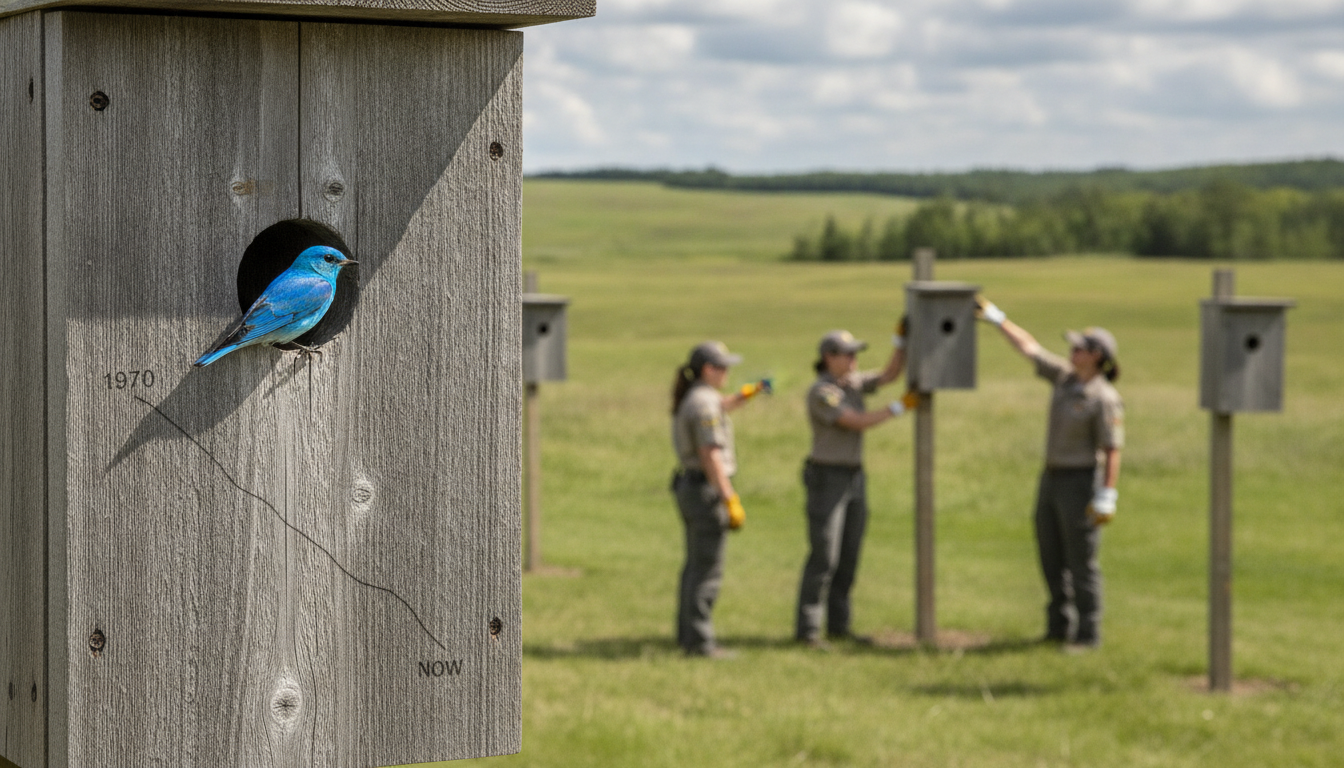
Mountain bluebird conservation ramps up in Alberta as volunteers expand nest-box network
Alberta volunteers expand nest-box programs to boost mountain bluebird numbers after a 60% national decline since 1970, urging policy action.
Mountain bluebird numbers show long-term national decline
The mountain bluebird has become the focus of renewed conservation work in Alberta as volunteers and scientists respond to a steep long-term population drop. The species, commonly seen across the Canadian Prairies, has declined by roughly 60 per cent nationally since 1970, according to The State of Canada’s Birds report. That decline, documented through a mix of professional research and citizen science monitoring, has placed the mountain bluebird at its lowest recorded abundance in Canada to date.
Recent assessments estimate about 650,000 mountain bluebirds remain in Canada, which represents roughly 12 per cent of the species’ North American population. Population trends show a complex history: numbers rose quickly in some Prairie areas between the early 1980s and the mid-1990s, then reversed course and began a sustained fall. Conservation groups say the scale and pace of the recent decline have prompted local action in regions such as the Drumheller Valley.
Data and science behind the decline
The population figures come from national monitoring programs that combine professional surveys with volunteer contributions, a methodology that has become central to tracking many bird species. Birds Canada and Environment and Climate Change Canada contribute to The State of Canada’s Birds, which synthesizes multiple datasets to report on trends. Experts emphasize that long-term datasets are essential for detecting multi-decadal shifts that single-year studies would miss.
Scientists caution that the reasons for the mountain bluebird’s decline are not fully resolved and likely involve multiple interacting pressures. Analyses point toward habitat change, climate variability, and reductions in insect prey as probable contributors. Conservationists urge policymakers and land managers to treat the decline as a warning sign for prairie ecosystems more broadly, rather than an isolated issue limited to a single species.
Local volunteers install and monitor nest boxes in Drumheller Valley
In response to the declining trend, community groups in Alberta have stepped up hands-on conservation work. The Badlands Trail Society, a volunteer organization active around Drumheller, now operates 48 nest boxes across the valley and nearby lands. The project was developed with guidance from experienced local bluebird stewards and operates on Nature Conservancy of Canada property where the open prairie provides suitable habitat and abundant foraging opportunities.
Volunteers check boxes, record occupancy, and manage nest sites to reduce predation and competition from invasive cavity-nesting species. Founders of the Badlands Trail Society describe the boxes as targeted support to compensate for the scarcity of natural tree cavities and other traditional nesting sites in the prairie landscape. The group also uses monitoring to inform broader stewardship decisions and to share findings with regional conservation partners.
How nest boxes and habitat management help breeding success
Nest boxes provide secure cavities where mountain bluebirds can lay eggs and raise chicks in landscapes where natural hollows are uncommon. In prairie ecosystems, suitable nesting sites can be limited because mature trees and snag structures are sparse on open grasslands. Properly designed and sited boxes mimic natural cavities and, when maintained, can significantly increase local breeding success for cavity-nesting species.
Management practices include placing boxes at appropriate heights, orienting entrances away from prevailing winds, and conducting regular checks outside of sensitive breeding windows when possible. Volunteers also use predator guards and spacing strategies to reduce competition from starlings and sparrows. While nest boxes are not a substitute for intact habitat, they are a practical tool that can make a measurable difference at local scales when combined with habitat protection.
Potential drivers: climate shifts, habitat loss and insect declines
Researchers cite several likely drivers behind mountain bluebird declines, though no single cause has been isolated as the definitive explanation. Climate change affects timing of insect emergence and availability, which can disrupt food supplies for insectivorous birds during critical breeding months. Warmer springs and altered rainfall patterns have had varied impacts across the species’ range, sometimes improving conditions in one year and reducing prey abundance in another.
Land-use change on the Prairies — including conversion of native grasslands to agriculture, roadside mowing practices, and the loss of uncultivated foraging areas — reduces both nesting and feeding opportunities. Additionally, widespread declines in insects, linked in part to pesticide and herbicide use, reduce the calorie-dense prey that adult bluebirds need to feed nestlings. Scientists emphasize that these pressures often act together, producing larger-than-expected effects on bird populations.
Citizen science and public engagement fueling monitoring and awareness
The mountain bluebird’s vivid coloration and open-country habits have made it an accessible subject for public engagement, and that interest has translated into meaningful conservation data. Volunteer observers contribute sightings and nest-box records to national monitoring programs, helping fill seasonal and geographic coverage gaps that professional surveys cannot always reach. Conservationists underline that this public involvement improves both scientific understanding and local stewardship.
Groups such as Birds Canada rely on tens of thousands of observations from volunteers to refine trend estimates and to identify priority areas for action. Local projects like the Badlands Trail Society also use outreach to teach residents how to identify nesting behaviour, report observations, and take simple steps to reduce threats. Those outreach efforts broaden the base of support for prairie habitat protection and create opportunities for education about insect conservation and land management.
Practical steps Canadians can take to help mountain bluebirds and other birds
Conservationists recommend a suite of actions that individuals and communities can adopt to benefit mountain bluebirds and a wider array of species. Reducing or eliminating pesticide and herbicide use preserves insect populations that are critical bird prey, particularly during the breeding season. Planting native grasses and pollinator-friendly plants in private and community spaces provides forage and structural habitat that support insects and foraging birds.
Other straightforward measures include keeping domestic cats indoors, which reduces predation on adult birds and fledglings, and mitigating window collisions by applying visible patterns or screens to glass on houses and public buildings. Supporting established nest-box programs and following guidance on proper box design and placement helps ensure volunteer efforts have positive outcomes. Conservation groups also encourage landowners to retain fence posts, hedgerows, and isolated trees where safe, as these structures provide perches and potential nesting habitat.
What the mountain bluebird tells us about prairie ecosystem health
Conservationists describe birds as indicator species because shifts in their numbers often reflect broader environmental changes. The mountain bluebird’s decline is therefore read as more than a trend affecting a single charismatic species; it signals changing conditions across the Prairies that may be affecting other wildlife and ecological functions. When insectivorous birds decline, the implications extend to pollination, pest control, and the resilience of grassland systems.
The visible nature of mountain bluebirds — males’ bright blue plumage, their presence in open country, and their appeal to birdwatchers — has made them an effective ambassador for prairie conservation. Volunteers and scientists argue that engaging the public around a species people can easily see and enjoy is a practical way to build momentum for policies and practices that restore habitat, reduce chemical inputs, and protect migration corridors.
Coordination between local efforts and national policy priorities
Local nest-box programs and volunteer monitoring are often the first line of defense for vulnerable species, but experts stress that broader policy measures are also necessary. Conservation organizations are calling for agricultural practices that maintain native grassland patches, incentives for habitat-friendly land management, and measures to curb insect declines associated with chemical use. Coordinated action between municipalities, provincial agencies, and federal conservation programs is key to scaling local successes.
Policy responses may include supporting conservation easements, investing in native prairie restoration, and funding long-term monitoring programs that can detect trends and evaluate interventions. Scientists also recommend that funders prioritize research into the relative importance of proposed drivers — such as insect declines versus habitat loss — so that management actions can be targeted and cost-effective. Volunteers say clear policy signals would help amplify the impact of community-led stewardship.
Community groups in Drumheller and elsewhere emphasize that monitoring and outreach create a virtuous cycle: higher public awareness yields more volunteers, better data, and stronger political will to protect habitat. That local-to-national connection is becoming central to conservation strategies for many species whose needs span private land, municipal greenspace, and protected areas.
Measuring success and looking ahead
Measuring recovery will require continued dedication to both monitoring and adaptive management. Nest-box programs can produce immediate local results, such as increased fledging rates, but monitoring must continue across seasons and years to assess whether those gains translate into lasting population increases. Conservationists plan to share standardized data from volunteer programs with national repositories so trends are tracked using consistent methods.
Long-term recovery likely depends on a combination of nest-site availability, stable food supplies, and intact landscapes that support foraging, migration, and wintering needs. Researchers advocate for integrated strategies that address these multiple needs simultaneously, and for funding mechanisms that sustain monitoring and habitat stewardship across decades. Volunteers remain optimistic but realistic: success will be incremental and will require persistent effort from individuals, communities, and governments.
Community pride in local species is a powerful motivator, and mountain bluebirds have proven particularly effective at drawing people into conservation. Local coordinators say that when residents volunteer to monitor nest boxes, they quickly become engaged in discussions about pesticide use, habitat management, and bird-friendly municipal planning. That ripple effect is part of why small, visible projects can yield broader environmental awareness and activity.
The mountain bluebird’s striking appearance and accessible habitat make it an ideal focal point for conservation education and action. As grassroots initiatives expand and connect with national monitoring and policy efforts, volunteers and scientists alike hope that targeted interventions will stabilize and eventually reverse the species’ decline. What happens next will depend on continued stewardship, informed land management, and the choices communities make about how to balance development with the needs of prairie ecosystems.
