
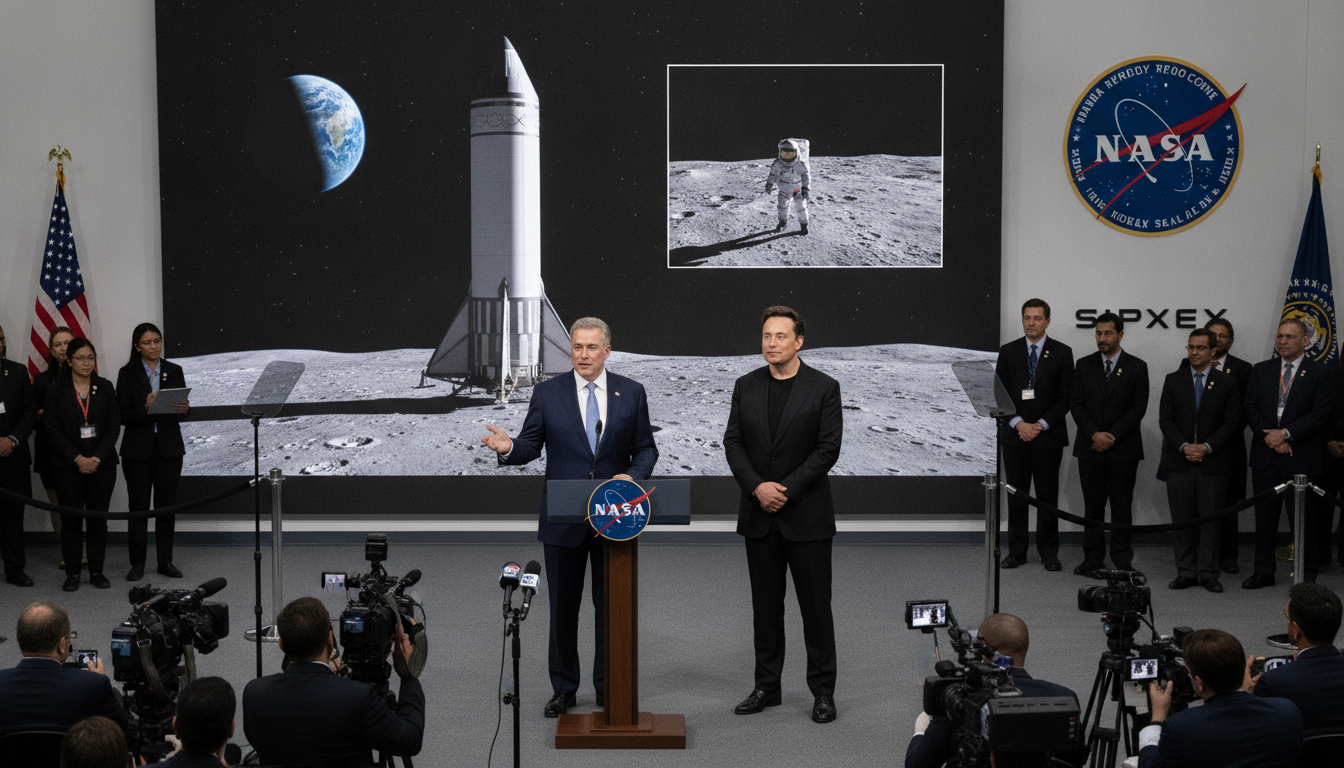
Starship rocket positioned as backbone for NASA lunar missions and SpaceX Mars plans
Starship rocket: SpaceX two-stage system aims to ferry astronauts to the Moon and ultimately reach Mars, combining towering dimensions with a fully reusable design.
SpaceX’s Starship rocket, a two-stage orbital launch system that the U.S. space agency NASA has identified as a candidate to carry astronauts to the Moon, represents a major shift in vehicle scale and operational thinking for crewed deep-space missions. The system, composed of a Super Heavy booster and a Starship upper stage, is designed to separate after liftoff and return to Earth for refurbishment and reuse. Its size—roughly 70 meters for the booster and 50 meters for the upper stage, creating a combined vehicle taller than the Statue of Liberty—symbolizes both engineering ambition and the commercial appetite for lower-cost access to deep space.
Mission roles assigned by NASA and SpaceX
SpaceX intends the Starship rocket to serve a broad portfolio of missions, from cargo and crew transport to sustained exploration efforts beyond low Earth orbit. NASA has selected Starship as a platform to deliver astronauts to lunar orbit and surface operations as part of its human exploration plans. SpaceX, for its part, frames the vehicle as the cornerstone of a long-term strategy to make Mars reachable for crewed missions and eventual sustained presence.
Two-stage architecture and vehicle dimensions
The Starship rocket is built around a staged concept: a powerful first stage called Super Heavy and a second stage that doubles as the spacecraft, also named Starship. The Super Heavy booster measures about 70 meters in height and provides the initial thrust to escape Earth’s dense lower atmosphere, while the upper stage stands around 50 meters and carries crew, cargo, or refueling propellant to orbit. When stacked, the vehicle’s combined height approaches 120 meters, a scale that changes the logistical and ground-support demands compared with previous generation rockets.
Reusability engineered into both stages
A central design goal for the Starship rocket is full or near-full reusability: both the Super Heavy booster and the Starship upper stage are intended to return to Earth and be prepared for subsequent flights. Reusability targets are intended to slash per-launch costs by replacing expendable hardware with vehicles that can be rapidly turned around. Achieving reliable turnaround at scale will require advances in thermal protection, structural refurbishment, and operations planning that are different in scope from conventional expendable rockets.
Testing progress and technical hurdles
Progress on Starship has relied on iterative testing across propulsion, stage separation, atmospheric re-entry and landing concepts, with each trial intended to advance system understanding. Key technical hurdles include ensuring consistent engine performance across many sea-level and vacuum-optimized engines, validating controlled stage separation at high dynamic pressures, and protecting the upper stage during hypersonic re-entry. Regulatory approvals, range safety coordination and recovery logistics for such a large vehicle also add operational complexity before routine flights can be established.
Implications for lunar operations and science
If the Starship rocket reaches its performance and reliability targets, it could reshape how agencies and commercial companies plan lunar missions by enabling larger payloads and longer surface stays. A vehicle capable of delivering crew and significant cargo in a single launch would simplify aspects of mission architecture, potentially enabling new kinds of science payloads and surface infrastructure. The availability of a high-capacity, reusable transporter may also influence international and commercial partnerships by changing cost and cadence assumptions for sustained lunar activity.
SpaceX’s long-range Mars objectives
Beyond lunar applications, SpaceX positions the Starship rocket as the platform for crewed flights to Mars that would support exploration and, ultimately, settlement goals. That ambition requires a sequence of technical milestones beyond Earth orbit, including in-space refueling, autonomous cargo pre-deployment, and life-support systems suitable for long-duration transit and surface operations. The pace at which those capabilities are demonstrated will determine how soon Mars missions move from conceptual planning to executable timelines.
The Starship rocket’s combination of unprecedented scale and a philosophy of rapid iteration has already altered conversations about the economics and logistics of deep-space travel. Whether the vehicle achieves routine reusability and the reliability demanded for crewed lunar and Martian missions will depend on continued testing, proven engineering solutions, and coordinated oversight from regulators and partners.
