
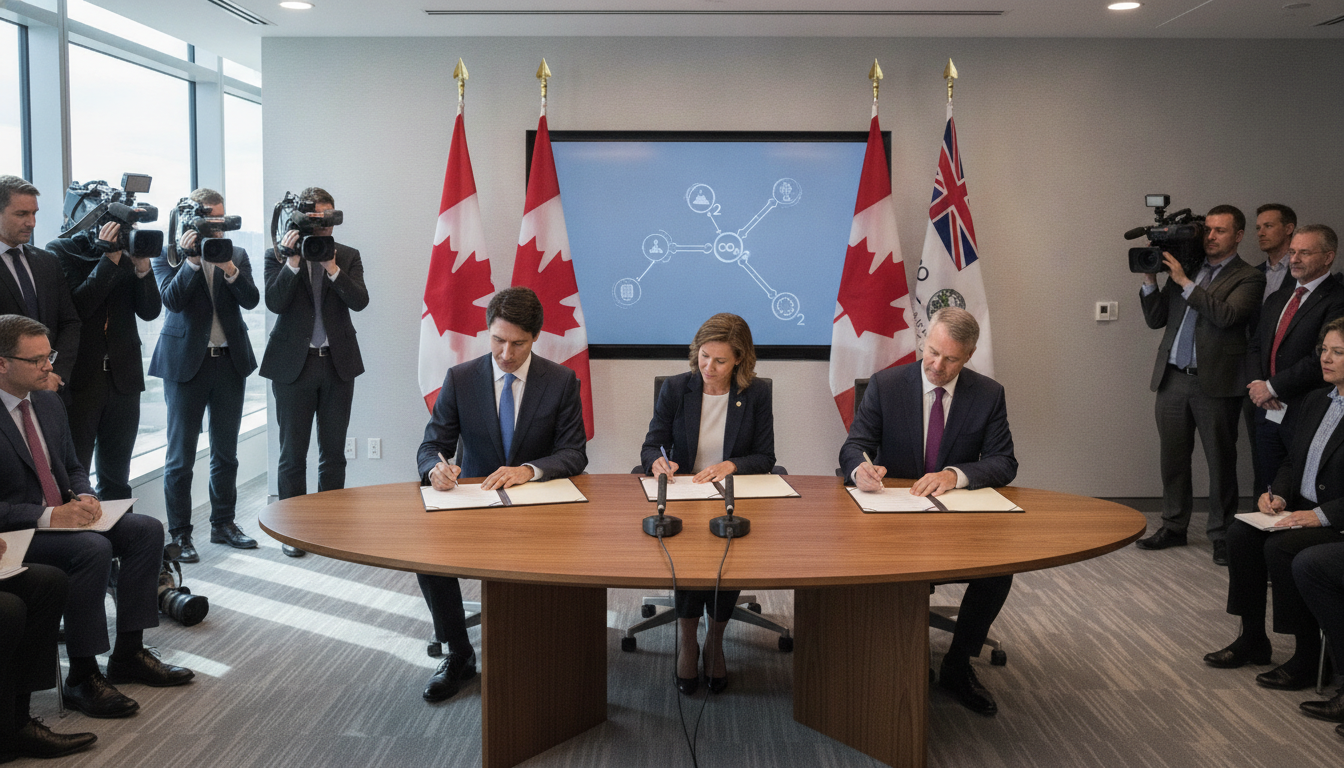
Alberta and Ottawa sign major protocol to advance Pathways carbon-capture project
Canada and Alberta sign protocol with oil‑sands consortium to back Pathways, a multi‑billion‑dollar carbon‑capture scheme tied to pipeline expansion and increased production.
The federal government, the Alberta government and the five major oil‑sands producers announced on July 14, 2026, that they have signed a protocol of agreement to advance the Pathways carbon‑capture and storage project.
The deal establishes a policy and fiscal framework intended to unlock tens of billions in federal and industry investment and to make Pathways a prerequisite for a proposed pipeline to British Columbia’s west coast.
Governments and industry sign protocol to advance Pathways
The memorandum sets out shared commitments between Ottawa, Edmonton and the Alliance of Oil Sands Producers — made up of Canadian Natural Resources, Imperial, Suncor, Cenovus and ConocoPhillips — to proceed with a staged buildout of the Pathways network.
Officials said the framework will align incentives and regulatory steps so that the carbon‑capture infrastructure can be deployed in concert with expanded oil‑sands output and new export capacity.
Planned capture capacity and a 2035 completion date
Under the agreement, Pathways is designed to transport and permanently store about 6 million tonnes of captured CO2 per year once fully operational.
The protocol sets a staged implementation schedule and identifies January 1, 2035, as the target completion date for the full system, with capacity increases aimed for the mid‑2030s.
Tax incentives, provincial measures and job claims
Ottawa committed to extend investment tax credits for carbon‑capture equipment through 2035, offering 50 percent credits for eligible capture hardware and 37.5 percent for associated transport, storage and utilization equipment.
Alberta said it will finalize a provincial incentive program to complement federal measures, and governments expect the project to support as many as 40,000 jobs across Canada during construction and operation phases.
Projected costs and who will pay
Initial public estimates placed the cost of Pathways at roughly $16.5 billion, but industry leaders have suggested the final bill could be substantially higher.
At a June energy conference, Cenovus chief executive Jon McKenzie indicated the project cost may range between $20 billion and $30 billion, underscoring the scale of private and public financing that will be required.
Emissions context and environmental criticism
The agreement comes amid scrutiny over the oil‑sands sector’s contribution to Canada’s greenhouse‑gas inventory, with data pointing to significant emissions from thermal production methods.
Environmental groups, including Greenpeace Canada, have warned that capturing a portion of emissions does not offset new pollution tied to expanded pipeline capacity, arguing the reductions promised under Pathways would cover a small share of current sector emissions.
Industry goals and Alberta production targets
The Alliance reiterated that Pathways is conditional on final contracts and regulatory approvals, and stressed the project would help maintain Canada’s competitiveness for energy investment.
Alberta has publicly set an ambition to raise crude production to about 8 million barrels per day within the next 10 to 15 years, noting recent growth that pushed provincial output to a record 4.8 million barrels per day in December 2025, up from roughly 4.1 million in October 2022.
Regulatory hurdles and a November 15 deadline for final agreements
Officials said binding agreements between Ottawa, the Alberta government and each Alliance partner must be signed by November 15, 2026, or the protocol’s framework will need reassessment.
Pathways still requires a sequence of regulatory approvals at federal and provincial levels, environmental assessments and detailed permitting before construction can advance at scale.
The protocol marks a significant pivot in federal‑provincial relations around energy infrastructure, tying major carbon‑capture ambitions to plans for export growth and domestic oil‑sands expansion.
Its ultimate success will depend on the balance struck between public subsidies, private capital commitments, regulatory clearance and the degree to which the system can meaningfully reduce net emissions while accommodating increased production.
