
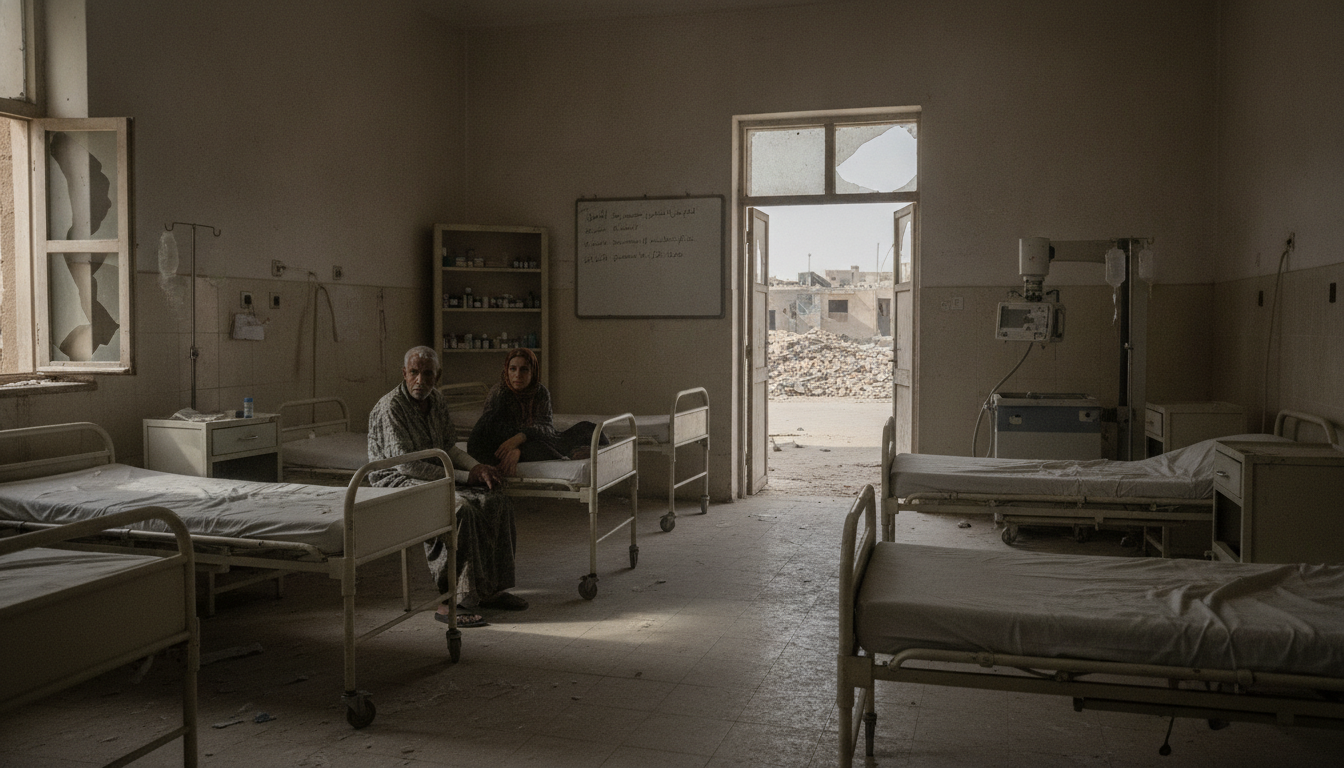
Yemen brain drain leaves patients without care as hospitals struggle to staff specialists
Yemen brain drain is leaving thousands without access to basic treatment as specialists flee conflict and collapse, forcing patients in Taiz and across the country to forego or postpone critical care.
Porter sidelined after decades of work
Ahmed Nagi, a porter from al-Turbah market in Taiz, can no longer work after developing a serious liver condition that left him reliant on a walking stick and unable to pay for medicine.
For more than 30 years Nagi earned a living helping shoppers carry goods, supporting a household of seven, until illness made him immobile and unemployed.
Local hospitals provided only rudimentary care and referred him to specialised centres in Sanaa or Aden, travel he cannot afford. He has relied on short-term charity for medicines, but his condition has progressively worsened.
Cataract operation leaves vision lost
In neighbouring communities, 45-year-old Taha Nabil waited years for an ophthalmologist, saved for surgery and then lost sight in his right eye after a procedure he expected to be routine.
Nabil now faces the very real prospect of losing vision in his remaining eye without access to skilled ophthalmology and the roughly $4,000 cost he cannot meet. He says he knows of specialists who might help, but the bill and scarcity of surgeons put care out of reach.
Medical professionals in Taiz warn that avoidable complications such as Nabil’s are rising as local surgical expertise disappears.
Healthcare workforce reduced to a fraction
The exodus of doctors has sharply reduced Yemen’s medical capacity. The World Bank and World Health Organization figures cited locally show physician ratios far below regional averages, leaving many districts with no doctors at all.
Years of conflict, irregular salary payments, damaged facilities and supply shortages have driven away staff, according to provincial health officials. In Taiz, authorities estimate a large portion of the medical workforce has been displaced or left the country entirely.
As clinics close or operate at minimal capacity, outbreaks of preventable diseases and routine conditions escalate into life-threatening problems.
Salaries, supplies and security push professionals out
Health officials point to low and delayed pay, broken equipment, and frequent power cuts as central drivers of the brain drain. Doctors and nurses have told colleagues they cannot support families on inconsistent wages or practise safely without basic supplies.
Security incidents have also discouraged both local and foreign staff. The killing of two visiting Syrian doctors at a government residence in Aden earlier this year is cited by officials as an example of the risks that complicate recruitment and retention.
Those who remain report taking on caseloads far beyond normal levels, performing operations and procedures that would typically be shared among larger teams.
Short-term fixes: foreign recruits and training gaps
Hospitals have responded by hiring foreign doctors, including Syrian specialists, as an emergency measure to fill critical gaps and transfer skills. These recruits have helped restore some services but are costly and limited in number.
Local health managers argue foreign hires are not a sustainable solution: recruitment expenses and security constraints limit scale, and the approach does not address the underlying problems of pay, infrastructure and long-term workforce planning.
Training and mentorship from visiting clinicians have offered temporary relief, but officials say rebuilding a domestic cadre of specialists will require stable funding and predictable salaries.
Patients face impossible choices every day
For many Yemenis, the choice is stark: travel to Sanaa, Aden or abroad for care they cannot afford, or accept worsening health at home. Those with means now travel to neighbouring countries for treatment; the poor must adapt or rely on intermittent charity.
The personal stories from Taiz — a porter unable to walk unaided, a man who lost vision after surgery — illustrate the human costs of a decimated health system. Local public health officials warn that without sustained investment and security, conditions will deteriorate further.
International partners and humanitarian agencies continue to provide some support, but health administrators say that assistance must be paired with measures to stabilize pay and ensure functioning facilities if the country is to retain or rebuild its medical workforce.
Yemen’s health sector now faces a long-term struggle to restore specialist services and protect patients from preventable disability and death.
