
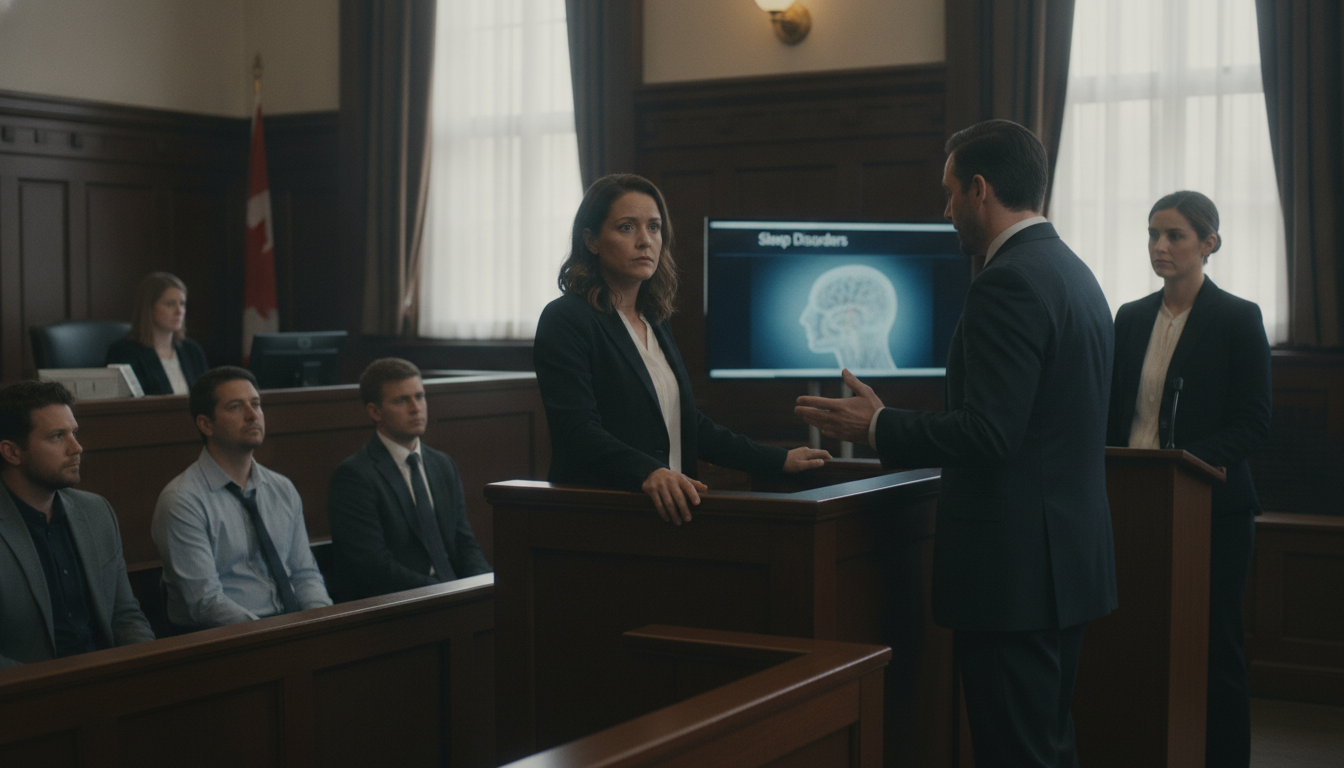
Calgary court examines sexsomnia defence as witness clarifies "woke up" phrasing
Calgary court hears complainant clarify use of the phrase "woke up" in an alleged Jan. 1, 2022 assault; sexsomnia defence and expert evidence are expected to be examined in the fall.
A woman testifying in Calgary on June 22, 2026 told jurors she did not use air quotes the first time she told police the accused “woke up” after forcing her to have sex, but said she did use the gesture on later occasions. The testimony came during cross-examination in a trial where the defence plans to raise a sexsomnia defence, and video of an October 2, 2024 police interview was shown to the court. The complainant’s account of a movie-night encounter on Jan. 1, 2022, remains central to the Crown’s case.
Complainant recounts January 2022 encounter
The witness described inviting her former partner to sleep over after a movie night and then being pinned to the bed, struggling and screaming as the alleged assault occurred. She testified that the accused did not stop until he had finished and then, she said, claimed he had been asleep and “woke up.” The woman cannot be named under a publication ban, and the accused is also not identified because the two were intimate partners.
The Crown, represented in court by prosecutor Kenna Morris, emphasized the complainant’s description of the events and the sequence in which she reported them to police. Morris played segments of the recorded police interview to give jurors a chance to see how the complainant described the alleged assault soon after it occurred. The witness acknowledged variations in how she phrased those descriptions when she later saw the recordings.
Video of police interview examined in court
Prosecutors showed two clips from the Oct. 2, 2024 interview with a Calgary police detective after defence counsel raised the complainant’s use of the words “woke up” on three separate occasions. In the courtroom, jurors watched the witness respond to questions and recount what she said to officers at the time. The exchange aimed to clarify whether she had intended to use quotation gestures — commonly called air quotes — to relay the accused’s own words.
When asked directly whether she used air quotes while saying he “woke up,” the witness confirmed that she believed she had given them on the second and third references. She conceded she did not mark the first instance with air quotes in the recording, explaining she thought she had done so at the time. The prosecutor and defence both probed the distinctions between reporting a statement and asserting it as fact.
Defence signals sexsomnia defence to be raised
Defence lawyer Allan Fay has indicated his client will assert sexsomnia, a sleep disorder in which involuntary sexual behaviour can occur during sleep, as a possible defence. The defence strategy has focused attention on whether the accused was asleep during the encounter and whether his actions were voluntary. Fay’s cross-examination on Monday and the subsequent playing of the police interview were aimed at casting doubt on the complainant’s characterization of the accused’s state.
The complainant testified that the accused told her he experienced an “out-of-body” sensation during the encounter, a remark that has figured in earlier court reporting and became part of Tuesday’s testimony. The defence will likely call expert witnesses to explain sleep disorders and the clinical features of sexsomnia if the court allows such evidence, according to statements made in court.
Crown seeks expert witnesses on sleep disorders
Justice and counsel discussed the need for expert evidence after the testimony, and the case was adjourned to allow both sides to consider calling sleep specialists. The Crown may call experts to contest or contextualize the expected sexsomnia defence and to explain whether the clinical literature supports involuntary sexual behaviour during sleep in the circumstances described. The judge has indicated that expert evidence will be a central issue before the trial proceeds.
Experts would be asked to examine patterns of sleep behaviour, the plausibility of the accused’s claimed state, and whether any medical history or contemporaneous evidence supports involuntary acts. The Crown’s approach is likely to focus on corroborating details and the complainant’s contemporaneous statements to police, while the defence will aim to demonstrate a medical basis for the accused’s alleged lack of awareness.
Cross-examination centered on phrasing and credibility
Much of Tuesday’s exchange focused on the precise words the complainant used and whether she intended to attribute the phrase “woke up” to the accused or to report it as her own observation. Fay’s cross-examination of the witness on Monday highlighted the three instances of the phrase in her police interview, prompting the Crown to play additional footage on Tuesday. The lines of questioning reflect how subtle differences in testimony can become pivotal in cases that hinge on consent and state of mind.
The complainant explained she used the phrase to report the accused’s own assertion that he had been sleeping, and she maintained that two of the three occasions in the interview were framed as quotations. The defence’s focus on wording is designed to raise questions about memory, perception, and the reliability of post-event statements, all of which jurors will weigh alongside other evidence.
Timeline for expert evidence and next court dates
The matter has been adjourned until the fall to provide time for both the Crown and defence to secure and prepare expert witnesses on sleep disorders. A continuation date will be set next month to formalize the schedule for those proposed experts and other pretrial matters. The timeline gives parties an opportunity to exchange reports and determine the scope of scientific testimony that will be allowed before the jury.
Court officials confirmed the case will return later in the year, when expert testimony, if admitted, could reshape the issues before the jury. Until then, the legal teams will gather clinical opinions and prepare to argue the relevance and admissibility of sleep-disorder evidence.
The outcome of the expert hearings may be decisive in determining whether the jury will be asked to consider sexsomnia as a factor in assessing the accused’s culpability, and jurors will ultimately decide the facts once all evidence is presented.
