
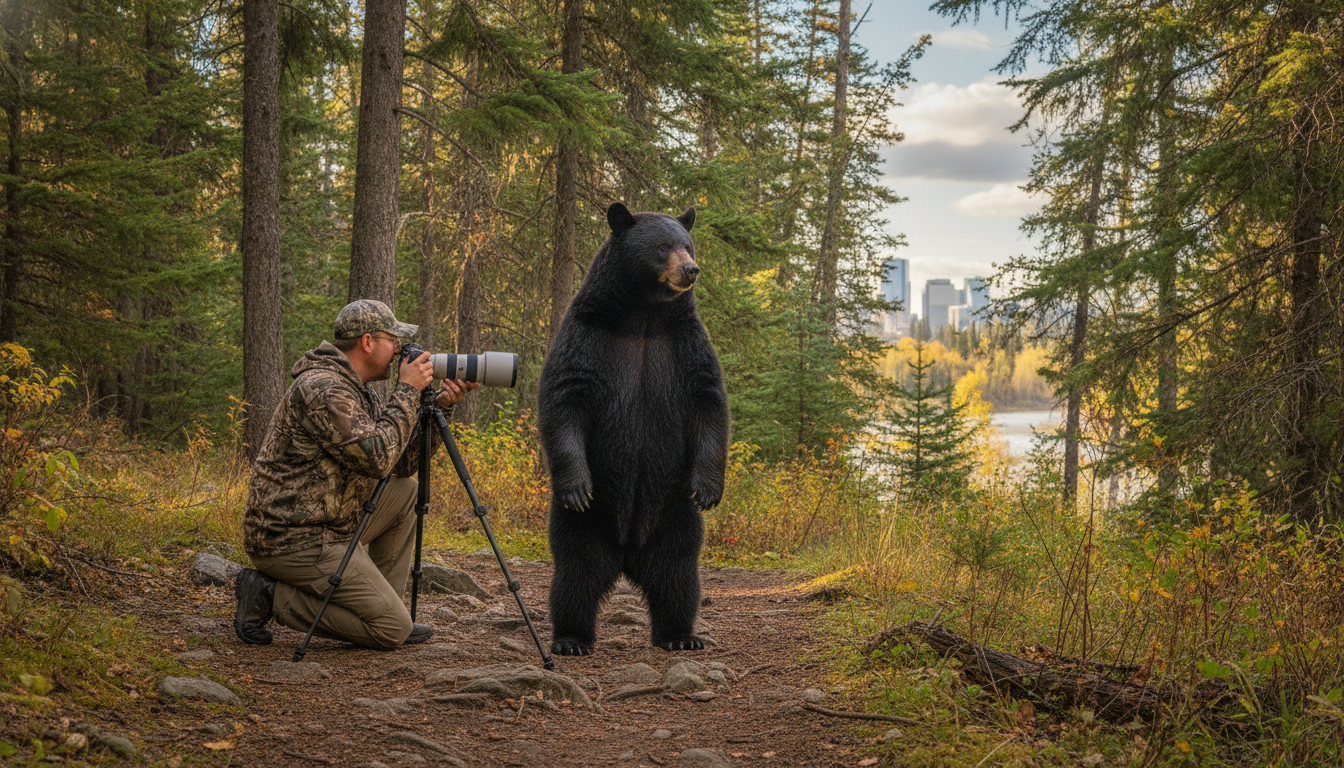
Black bear sighting in Fish Creek Provincial Park prompts safety reminders for visitors
A juvenile black bear was photographed and reported in Fish Creek Provincial Park on June 16, 2026, prompting multiple sightings and safety advice for park users. The Fish Creek black bear encounter, captured by a local wildlife photographer, has highlighted the frequency of bear activity in southwest Calgary green spaces. Authorities say the animal showed no signs of aggression but urged caution as the province monitors the area.
Photographer describes face‑to‑face encounter
Wildlife photographer Mike Reece went to Fish Creek Provincial Park to photograph owls and instead came upon a dark shape in dense brush. He wrote that the animal emerged less than two metres from his position and looked directly at him before moving toward the river. Reece followed the animal’s movements and later photographed the bear again near a beaver dam, capturing striking images of a small black bear navigating logs and shoreline vegetation.
Reece told reporters he did not have time to use his usual loud calls to scare off wildlife and instead backed away to avoid a second close approach. He said the bear appeared to be feeding on cattails and was minimally disturbed by nearby beavers, which were slapping their tails in alarm. Reece has since said he plans to carry bear spray on future visits to Fish Creek.
Multiple reports place bear around Marshall Springs and Bebo Grove
Alberta Fish and Wildlife Enforcement Services (FWES) confirmed that since June 16, 2026, it has received a string of reports of a small black bear within Fish Creek Provincial Park. Sightings have concentrated in green-space pockets identified by FWES as Marshall Springs, Votier’s Flats, and Bebo Grove, all within the southwest portion of the park. The agency has not received reports of aggressive behaviour associated with the animal.
FWES described the bear as likely juvenile and said sightings have been limited to natural park areas rather than residential backyards. The province said there is no evidence the animal has been accessing unnatural food sources such as garbage or bird feeders. Officials continue to monitor the situation and rely on public reports to build a situational picture.
Wildlife biologist outlines habitat and movement patterns
Calgary wildlife biologist Sara Jordan‑McLachlan noted that bear visits to Fish Creek and surrounding corridors are not unusual given the habitat’s food availability and connectivity. She explained that the park features abundant berry bushes, tuber-rich soils and other seasonal food items that attract foraging black bears. The green spaces also form part of a larger wildlife corridor that species use to move between riparian habitats and upland areas.
Jordan‑McLachlan advised that the bear’s presence during daylight hours likely reflects normal foraging behaviour rather than aggressive intent toward people. She cautioned, however, that focused feeding can make an otherwise non‑aggressive bear less aware of nearby people, creating a risk for defensive responses if surprise encounters occur. Her guidance emphasized reducing chances of startling wildlife by staying on designated trails and making noise in denser areas.
City role and public guidance for park users
The City of Calgary said it does not track individual bear sightings and does not directly respond to bear encounters within municipal jurisdiction. Instead, the city’s online materials list neighbourhoods and green spaces where bears have been known to venture, most of which are in Calgary’s southwest quadrant. Municipal advice focuses on removing attractants from residential properties and following bear safety best practices when in parkland.
Provincial officials and wildlife officers recommend that park users carry deterrents such as bear spray and that they refrain from approaching or attempting to photograph bears at close range. FWES advised against congregating to search for or trail the animal, noting that increased human presence can cause a wild animal to feel cornered and more likely to act defensively. Visitors are urged to report sightings to Alberta Fish and Wildlife through the channels provided by the agency.
Behavioural cues and signs observed at the scene
Observers who encountered the juvenile bear reported it engaging in routine behaviours such as climbing logs and feeding on shoreline vegetation. Reece’s photos show the small black bear on fallen timber near a beaver dam and peering through cattail stands, which are typical food and travel features in riparian zones. Nearby beaver activity, indicated by tail slaps and construction, appeared to have added to the commotion but did not provoke the bear into overtly defensive actions.
FWES said there were no signs that the bear was habituated to human food or intentional interaction with people at the time of the reports. That assessment is significant because bears that associate humans with food often escalate risk and may require capture and relocation. For now, the juvenile bear’s natural foraging behaviour suggests lower immediate risk, but officials stress that ongoing monitoring is necessary to detect any change.
Previous relocations and management actions in the area
Alberta Fish and Wildlife has previously captured and relocated bears found in Calgary neighbourhoods, including relocations and tranquilizations carried out last year. Those interventions occurred after reports of repeated sightings or confirmed access to human attractants, and they were undertaken to reduce public safety risks and to restore the animals to more suitable habitat. In some instances in past seasons, bears have been captured within residential areas and moved outside the city limits to limit future conflict.
FWES officials say that relocation is reserved for cases where bears pose an immediate threat or have become food‑conditioned around human environments. Otherwise, management focuses on public education, reporting and preventative measures such as securing garbage and removing bird feeders. The province urged Calgary residents and park visitors to follow recommendations that limit the potential for repeat interactions.
Practical steps for visitors encountering a bear
Wildlife authorities recommend several practical steps for park users who encounter a bear at close range, beginning with remaining calm and avoiding sudden movements. People are advised to give the animal space, move away slowly while facing the bear, and to avoid turning and running, which can trigger a pursuit response. Making noise, appearing larger by raising arms, and using bear spray if the animal behaves aggressively are indicated defensive options.
Officials also recommend that groups stay together and supervise children and pets closely in areas with recent sightings. Keeping dogs on a leash reduces the chance of a dog provoking a bear or leading it back toward people. Reporting the sighting to FWES helps wildlife officers track movements and warn other park users.
Wildlife encounters such as this Fish Creek black bear sighting underline the interface between urban green space and natural habitat. The province, wildlife experts, and local photographers all stress awareness and precaution rather than alarm. Visitors who follow guidance on attractant management and encounter response can help minimize risks for people and for the animals moving through Calgary’s parklands.
The juvenile black bear remains under observation by provincial wildlife services, and members of the public are asked to report new sightings rather than attempt to locate the animal themselves. Continued monitoring and public cooperation will guide any future management actions, while emphasizing coexistence strategies for wildlife in urban‑adjacent parks.
