
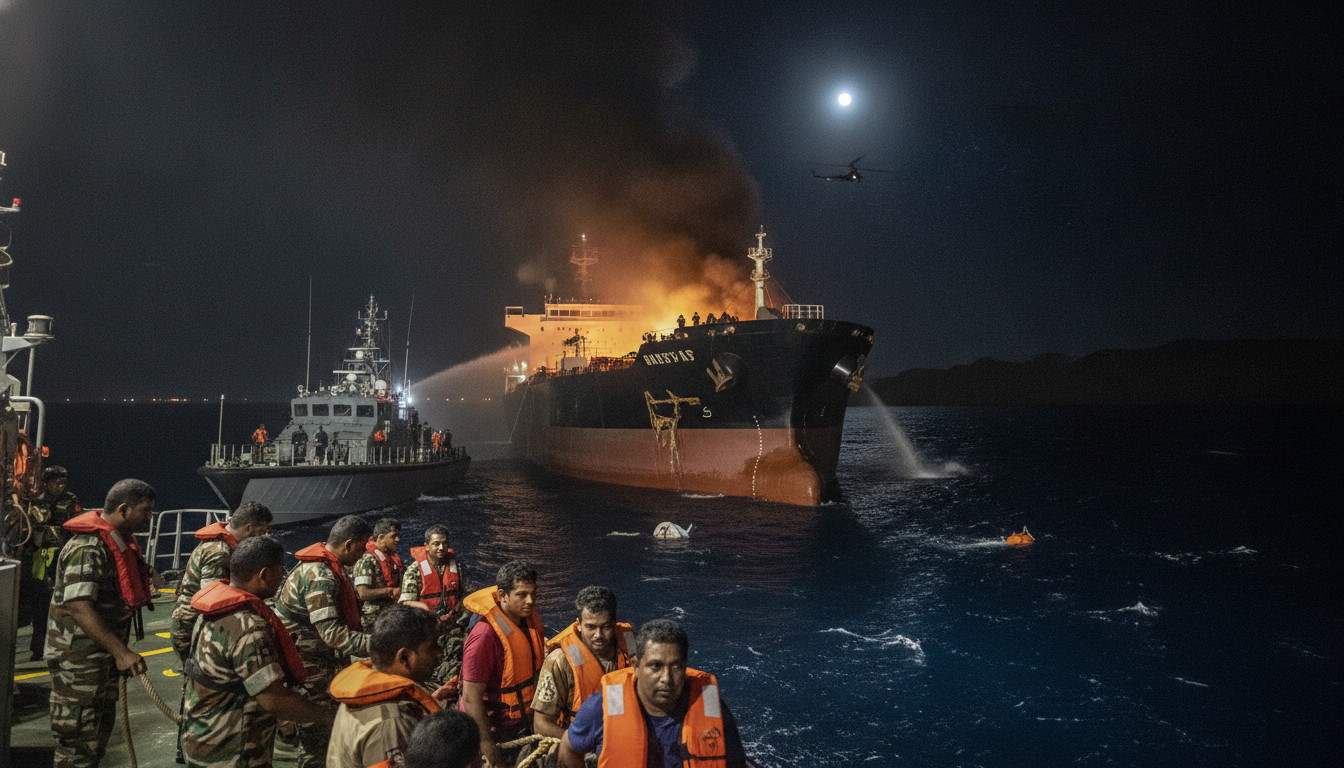
U.S. missile strikes tanker off Oman as Omani military rescues Indian sailors
U.S. missile strikes tanker off Oman: Indian sailors rescued after more than two hours of distress calls; Omani military recovered the crew on June 10, 2026.
On June 10, 2026, a tanker was struck by a U.S. missile in waters off Oman’s coast, triggering a prolonged distress period and a subsequent rescue by Omani forces. Indian sailors aboard the vessel sent distress calls for more than two hours before they were taken off the ship, officials said. U.S. Central Command stated the struck vessel had been attempting to sail to a port in Iran at the time of the attack.
U.S. missile strikes tanker off Oman
The strike occurred in international waters near Oman’s coast, where the tanker sustained damage and its crew was left in distress. U.S. Central Command released a statement identifying the vessel’s movement toward an Iranian port as a factor in the incident. Details on the strike’s timing and the munitions used were not immediately disclosed by U.S. authorities.
Indian authorities confirmed that Indian nationals were among the crew members affected by the strike, though they did not provide the exact number. International maritime traffic in the region has been under heightened scrutiny, and this incident marks a serious escalation with direct implications for merchant shipping.
Omani military rescues crew
Omani military units responded to distress signals and carried out a rescue operation that removed sailors from the damaged tanker. The operation concluded with the crew in Omani care, and authorities said they were assessing the crew’s medical condition and arranging onward assistance. Oman’s swift response prevented further immediate loss of life, officials noted.
Omani officials have not released a detailed operational timeline, but military sources described the rescue as coordinated and executed in challenging conditions. The rescue underscores Oman’s role as a first responder in regional maritime emergencies and its capacity to project search-and-rescue assets into nearby waters.
Distress calls and timeline
Survivors and monitoring stations reported that the tanker’s distress calls persisted for more than two hours before rescue forces arrived on scene. During that window, the crew repeatedly broadcast their situation, seeking assistance as the ship remained disabled. The extended duration of the distress calls raised questions about the immediacy of the strike’s aftermath and the accessibility of help in those waters.
Maritime authorities typically prioritize rapid coordination for such signals, but remote locations and tactical complications can delay immediate response. The prolonged calls will be a focus for investigators determining the sequence of events and the response times of regional vessels and military units.
Ship’s destination and U.S. account
U.S. Central Command said the tanker was attempting to sail to an Iranian port when it was struck, a detail that informed the decision to target the vessel. Officials did not provide further operational justification in initial statements, and they said inquiries were ongoing. Washington’s account has already prompted questions from regional partners and nations with citizens aboard the tanker.
The ship’s ownership, flag state and cargo manifest have not been publicly confirmed, and those facts will be central to any formal probes. Identifying the commercial and legal status of the vessel will shape diplomatic responses, insurance claims and potential regulatory action affecting maritime transit in the area.
Regional diplomatic response and concerns
India, which had citizens aboard the damaged tanker, is expected to seek detailed information from both Oman and the United States about the circumstances leading to the strike. Governments in the region routinely call for clarity and restraint in incidents that endanger civilian mariners and commercial traffic. Oman’s decision to conduct the rescue reiterates its diplomatic posture as a stabilizing actor on regional security matters.
Broader diplomatic repercussions could include calls for de-escalation from Gulf states and appeals to international maritime organizations to improve protections for civilian shipping. The incident may prompt emergency consultations among affected nations to assess the risks to merchant vessels and to coordinate protective measures.
Investigations and maritime safety implications
Authorities in Oman, the United States and the tanker’s flag and ownership states are expected to open investigations into the attack, the rescue operation and the sequence of communications. Investigators will examine whether the tanker posed a direct threat or was misidentified, the legality of the strike under international law, and whether proper procedures for targeting civilian vessels were followed. Findings from these probes will be critical for accountability and for any legal or diplomatic follow-up.
Maritime insurers and shipping companies will monitor the investigations closely, as the incident could affect routing decisions, insurance premiums and safety protocols for vessels operating in the wider Gulf and Arabian Sea region. Ship operators may reassess transit plans and seek additional security assurances in light of the risks highlighted by the strike.
The incident on June 10 underscores ongoing vulnerabilities in a strategically important maritime corridor and raises pressing questions about the protection of seafarers and the rules governing the use of force at sea.
