
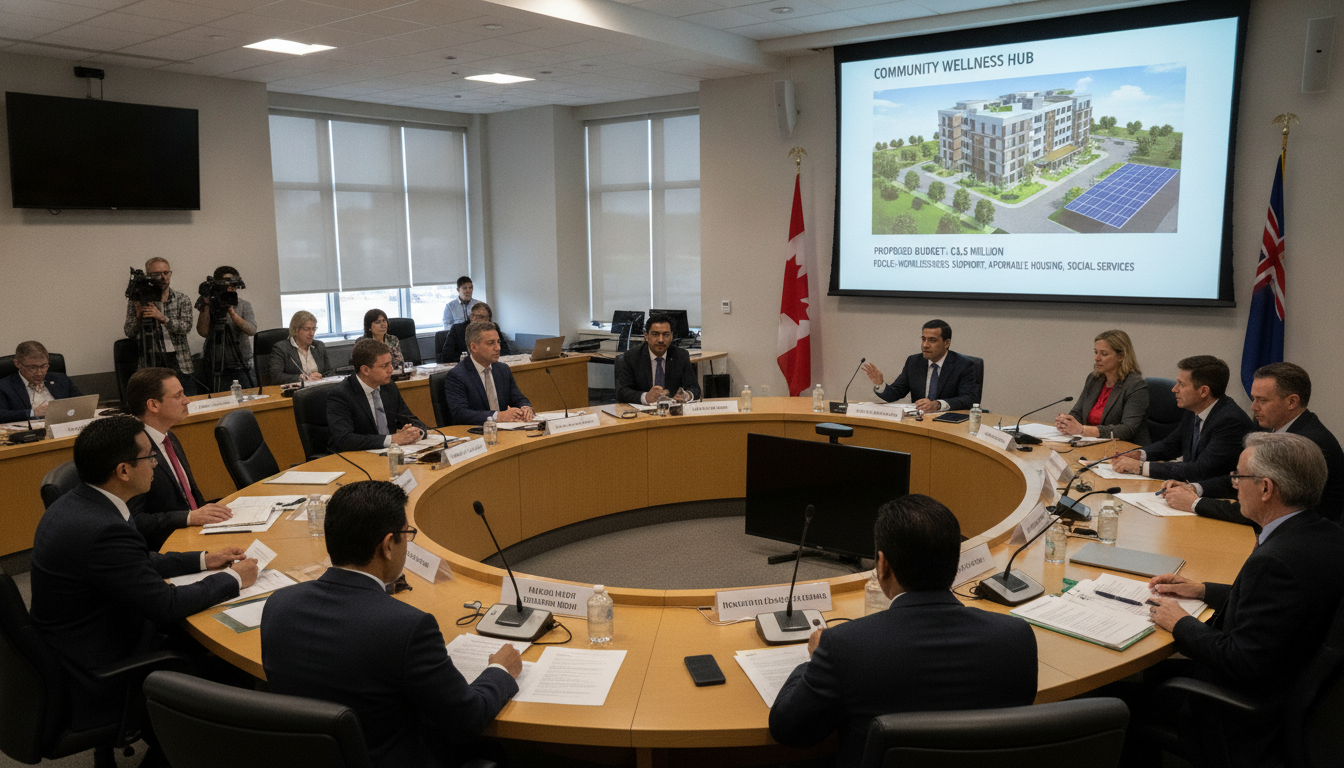
Edmonton council to review $6.5M community hub program to tackle rising street deaths
Edmonton council will consider a $6.5M plan for a year‑round day shelter and community hub program this year to address skyrocketing street deaths and homelessness.
A father’s alarming sight of a man slumped on a staircase helped push Edmonton council to seek urgent action on homelessness as it prepares to weigh a proposed community hub program. Council’s community and public service committee unanimously approved a motion from Mayor Andrew Knack to explore either a year‑round day shelter model or a broader, fully funded community hub program as part of the city’s four‑year budget deliberations.
Council motion and budget context
The committee approved the motion on Monday, flagging a $6.5-million service package for discussion during upcoming budget talks.
Mayor Knack framed the proposal as a response to what he described as an escalating public-health emergency, saying deaths on the street have risen sharply and require a concentrated, sustained effort.
Council members signaled they will seek clarity on funding sources, services included in a hub model, and how the initiative would connect with provincial and federal programs.
A frontline scene that prompted action
Jordan Reiniger, executive director of Boyle Street Community Services, recounted driving past a man who appeared to be dying, an incident his daughter first noticed.
Reiniger used the moment to emphasize that day spaces are not a cure for homelessness but are critical to preventing more visible and lethal crises on public streets.
He pointed to existing local examples, such as the Thunderbird Centre, as models for how community hubs can combine daytime respite with coordinated services.
Support from businesses and civic groups
Backing for the motion came from a range of stakeholders, including the Edmonton Downtown Business Association and the Edmonton Chamber of Commerce.
Braede Harris, operations director with the Downtown Business Association, said limited daytime options push people into libraries, transit stations and storefronts not built to provide social services, increasing costs for downtown businesses.
The association’s core patrol recorded more than 1,900 wellness checks between January and May, a figure cited to argue that dedicated day shelters would reduce pressure on public and private spaces.
Politicians stress the economic cost of inaction
Ward Ipiihkoohkanipiaohtsi Coun. Jon Morgan highlighted municipal and taxpayer expenses tied to the current situation, including first-responder calls, transit disruptions and encampment clean‑ups.
“We’re paying for this already,” Morgan said, urging council to weigh the long-term savings a coordinated community hub program might deliver.
Council members from across the political spectrum expressed willingness to press the provincial government to match rhetoric with funding.
Scope and services under consideration
City staff will be asked to outline what a year‑round day shelter would provide versus a full community hub program, and how either model would integrate with housing placements and mental-health supports.
Advocates say hubs typically combine warm daytime spaces, case management, harm‑reduction services and pathways to longer-term housing, while also coordinating with outreach teams and emergency services.
The committee motion seeks a clear plan that defines outcomes, operating costs, and how the city would measure success if the program is funded.
Housing advocates call for coordinated strategy
Stakeholders including Boyle Street Community Services argued that day spaces must be paired with expanded housing and coordinated supports to be effective.
Advocates warned that temporary shelters without clear ties to housing trajectories can offer short-term relief but will not reverse a crisis driven by a lack of affordable units and supports.
Mayor Knack urged an all‑levels‑of‑government approach, saying the city is ready to act if provincial funding commitments are forthcoming.
Plans to include the $6.5-million proposal in four‑year budget deliberations set the timeline for detailed reporting and public discussion. Council will seek further costing, operational models and input from community agencies before a final decision.
The motion and ensuing budget debate mark a significant municipal effort to shift from reactive measures to a structured suite of daytime services and supports, with proponents arguing that a funded community hub program could reduce deaths, stabilize people in need and lower long-term costs to the city.
