
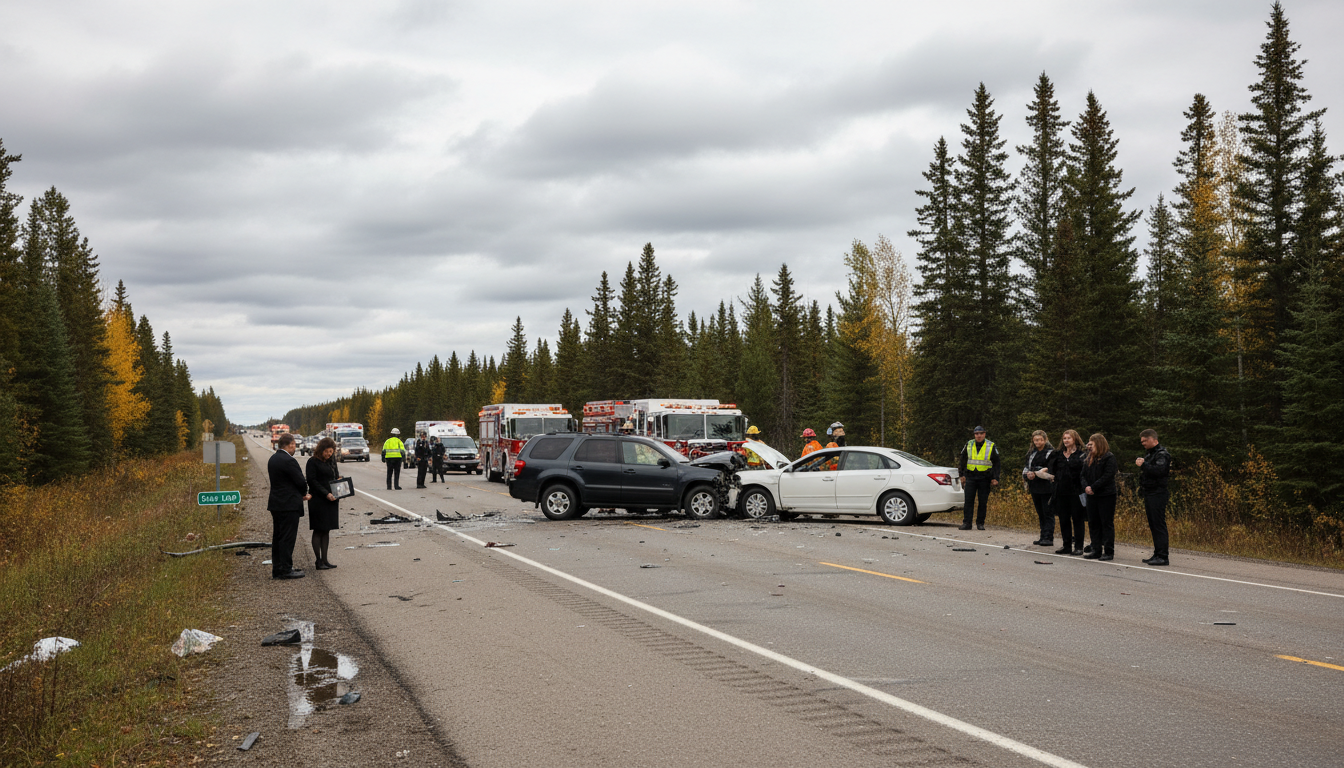
Cris Derksen killed in head-on crash near Slave Lake while returning from her father’s funeral
Cris Derksen, Juno-nominated Indigenous cellist, died in a head-on collision near Slave Lake on May 15 while returning from her father’s funeral, officials say.
Cris Derksen, a 45-year-old Juno‑nominated Indigenous cellist, died Friday evening in a head-on collision on a rural highway in northern Alberta as she was returning from her father’s funeral. Slave Lake RCMP responded to the two-vehicle crash on Highway 44 near Township Road 684 at about 6:32 p.m. on May 15, where emergency crews pronounced a female passenger dead at the scene.
The collision stunned Canada’s arts and Indigenous communities, who remembered Derksen as an innovative musician and mentor whose work blended classical technique with Indigenous traditions. Her death comes amid the grief of a family already mourning, and authorities have said the investigation into the cause of the crash is ongoing.
Collision on Highway 44
Slave Lake RCMP said initial investigators determined a northbound sport utility vehicle crossed the centre line and struck a southbound SUV in a head-on impact. Witness accounts collected by police indicate the northbound vehicle was traveling at a high rate of speed just before the collision.
Emergency medical services were at the scene and declared the female passenger of the southbound SUV deceased. The drivers of both vehicles were transported to hospital with serious injuries, and police have not yet released their identities pending notification of next of kin.
Police statement and investigation
RCMP Cpl. Matthew Howell said investigators have not found evidence to suggest drugs or alcohol were factors in the crash, and the matter remains under active investigation by traffic collision analysts. Police are continuing to interview witnesses and examine physical evidence from the scene as part of a standard reconstruction process.
Authorities asked anyone with dash-cam footage or information about the collision to contact Slave Lake RCMP to assist the ongoing inquiry. Howell offered condolences to the family and described the incident as a tragic sequence of events for relatives and community members.
Family, passengers and hospital reports
Reports from the scene and social media indicated Derksen was returning from her father’s funeral when the collision occurred, a detail police later confirmed, adding that the timing made the incident particularly devastating for the family. Friends and colleagues identified one survivor as Derksen’s wife, Rebecca “Bobby” Derksen, who was hospitalized in critical condition after the crash.
Hospital officials have not released detailed information about the conditions of the injured drivers or other passengers. Police said they will provide updates as more factual information becomes available and as family notifications are completed.
Musical career and recognition
Born and raised with roots in the North Tallcree reserve, Cris Derksen combined Cree and Mennonite heritage in a career that pushed the boundaries of string music in Canada and abroad. She trained at Victoria School for the Performing Arts in Edmonton and earned a bachelor of music from the University of British Columbia, where she served as principal cellist of the UBC Symphony Orchestra.
Derksen was widely known as an electric cellist and composer who mixed orchestral textures with Indigenous musical forms. Her projects included the 2015 Orchestral Powwow Project and the Cris Derksen Trio, and her choral work Maada’ookii Songlines involved hundreds of singers. Over her career she received nominations from the Juno Awards, Indigenous Music Awards, Aboriginal Peoples Choice Music Awards and other regional honours.
Reaction from the arts community
Derksen’s booking agency, AIM, described the news as being received “with profound, shattering sadness,” calling her a visionary artist whose work reflected heritage and innovation. Fellow musicians and collaborators posted tributes on social media, recalling her mentorship, generosity and prominent role in Indigenous classical music circles.
Banff Centre affiliates and colleagues noted Derksen’s dedication to mentorship and community-building, and musicians said her influence extended beyond performance into teaching and advocacy for Indigenous presence in classical and contemporary music spaces. The arts community has signaled plans for public remembrances in the coming days, though details were still being arranged at the time of publication.
Legacy and ongoing support
Derksen’s blending of traditional Indigenous music with contemporary string practice made her a distinctive figure on concert stages and in recording projects across Canada and internationally. Her work with ensembles and large-scale community choirs was praised for both its artistic reach and its cultural significance.
As investigations continue, friends and peers urged anyone wishing to support Derksen’s family to respect privacy while signalling solidarity. Community groups and arts organizations are coordinating memorials and fundraising efforts that will be announced publicly once families and organizers have had a chance to plan.
The sudden death of Cris Derksen marks a deep loss for her family, for Indigenous and classical music communities across Canada, and for audiences who admired her creative fusion of tradition and experimentation.
