
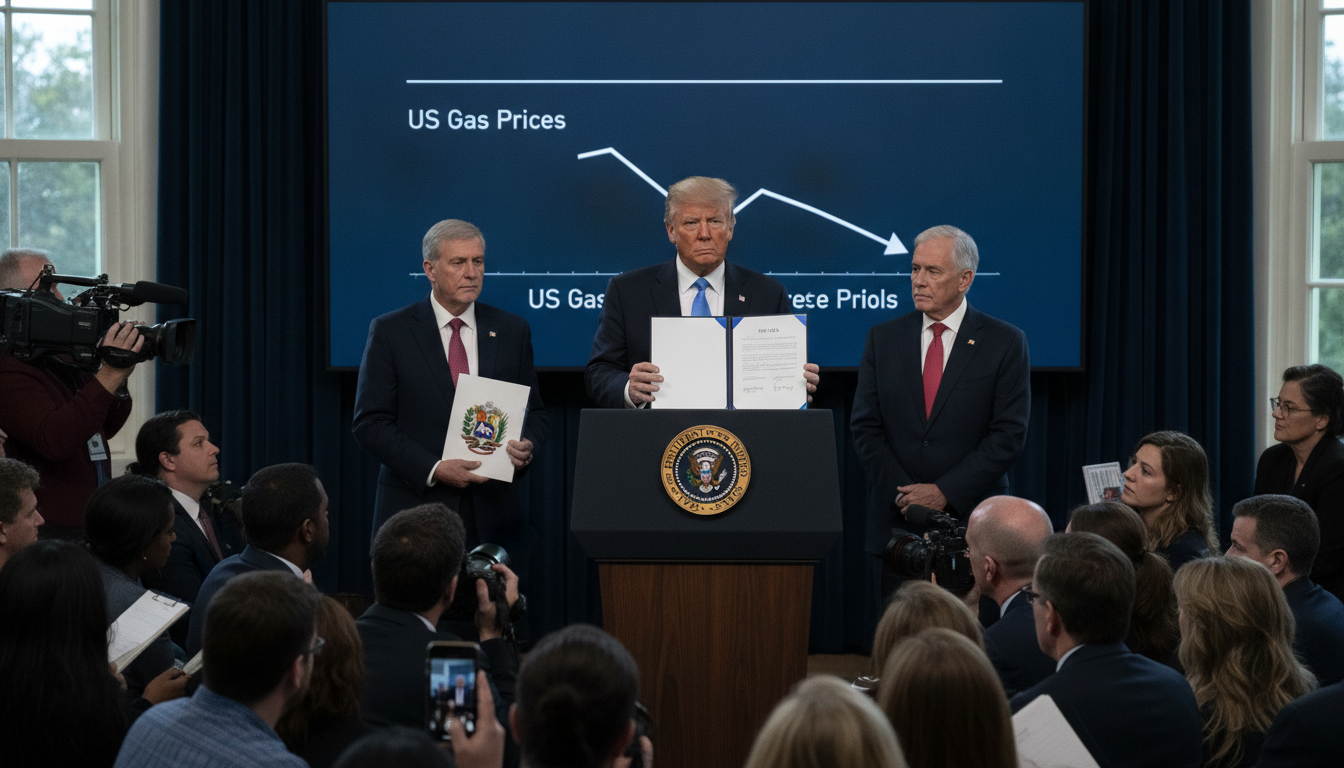
U.S.-Venezuela oil deal: what it promises and why gas prices likely won’t fall soon
US-Venezuela oil deal analysed: what the agreement entails, who benefits and why experts say it won’t produce immediate relief at the U.S. pump and markets
The US-Venezuela oil deal announced on Aug. 28 promises expanded access to Venezuela’s massive reserves, but analysts say the agreement is unlikely to lower gas prices for American drivers in the short term. The pact creates a private joint venture tying U.S. interests to North American Blue Energy Partners (NABEP) and assigns a significant stake to a Pentagon office. Practical limits — ageing Venezuelan infrastructure, refining constraints and geopolitical supply shocks — are expected to delay any consumer benefits.
Deal terms and U.S. stake
The agreement grants U.S.-linked entities control over a substantial portion of Venezuela’s proven reserves, with estimates in the deal pointing to more than 65 billion barrels falling under the new commercial arrangement. The White House outlined a structure in which the Pentagon’s Office of Strategic Capital takes roughly a 35 percent stake in NABEP, which is led by Venezuelan businessman Alejandro Betancourt. The venture is to be supported by U.S. auditors, lawyers and advisors and will guarantee the United States the right to purchase a share of output at cost.
The deal also envisions U.S. rigs, refineries and investment supporting increased Venezuelan flows, and it assigns Chevron and other international firms a role in expanding production. Venezuelan interim authorities have welcomed the return of foreign capital, while the arrangement provides a mechanism for U.S. companies to operate despite lingering sanctions on the country’s oil sector.
Production gains and physical limits in Venezuela
Despite the headline reserve numbers, turning Venezuelan oil into marketable output faces steep hurdles. Analysts note that Venezuela’s reserves are dominated by heavy, sour crude that requires specialized processing and substantial upfront investment to extract and upgrade. Years of underinvestment have left pipeline networks, power supplies and drilling systems degraded, creating “physical bottlenecks” that cannot be fixed overnight.
Even where wells can be restarted, the incremental barrels are often the easiest and cheapest to recover; more material increases in output will require costly drilling programs and facility upgrades. Industry sources warn that converting stockpiled reserves into flowing barrels is a long-term endeavour that will not immediately flood global markets.
Refining constraints and U.S. pump prices
U.S. Gulf Coast refineries are among the few facilities worldwide equipped to process Venezuela’s heavy grades, and that technical fit is central to the White House’s argument that American consumers will benefit. However, refinery throughput is already near capacity as operators meet both domestic demand and overseas commitments. Analysts say there is limited room to increase processing quickly without capacity expansion or operational upgrades.
The immediate impact on pump prices is further constrained by the time needed to transport, blend and refine heavy crude into finished fuels. Market participants caution that even if Venezuelan crude were available in larger volumes, the existing refining bottlenecks and distribution logistics mean motorists are unlikely to see meaningful price relief in the near term.
Market reaction and price movements
Financial markets did not react to the announcement with an immediate fall in crude prices. Data from trade analysts showed U.S. benchmark West Texas Intermediate rising past $90 a barrel and Brent trading in the mid-$90s soon after the deal was publicized. Observers attribute the climb to heightened geopolitical risk and ongoing disruptions to supplies routed through the Strait of Hormuz rather than to structural changes in Venezuelan output.
Traders and intelligence agencies report that hundreds of thousands of barrels per day have already been redirected from Venezuela to U.S. shores under eased operational conditions, but those flows represent a fraction of the global market. Experts stress that price dynamics remain dominated by short-term supply shocks and investor sentiment tied to the Middle East.
Global supply gaps and the Strait of Hormuz
A central obstacle to any rapid global price decline is the loss of lighter Gulf crudes previously shipped through the Strait of Hormuz. Analysts estimate that disruptions in the region removed millions of barrels per day from seaborne trade, a shortfall that heavier Venezuelan grades cannot easily replace. The differing quality of Venezuelan crude means it competes with other heavy suppliers, such as Canadian and Mexican oil, rather than substituting for light, low-sulphur Gulf barrels.
Industry economists also point to investor caution: the scale of capital required to revive and expand Venezuelan fields is immense, and political and operational risks could deter the deep-pocketed commitments needed to close the global supply gap. As a result, longer-term pressure on prices depends on both successful Venezuelan ramp-up and restoration of Gulf shipping routes.
Winners, losers and long-term outlook
U.S. oil companies appear to be among the principal near-term beneficiaries, with industry returns rising on expectations of expanded contracts and access. Officials have signalled that a broader slate of international firms may sign deals in Caracas, potentially increasing Venezuelan output gradually. Meanwhile, consumers and many refineries will likely see only incremental advantages until production and refining constraints are addressed.
Economists caution that while the deal may increase available heavy crude over time, its effect on global and domestic fuel prices will be gradual and contingent on significant investment and stability in Venezuela and the wider region. The policy’s ultimate impact will depend on whether operators can translate reserve figures into sustained flows and whether geopolitical tensions ease enough to restore broader seaborne trade.
The US-Venezuela oil deal represents a strategic bet that access and investment can unlock Venezuela’s vast resources, but experts say the path from reserves to cheaper fuel at the pump is long and uncertain.
