
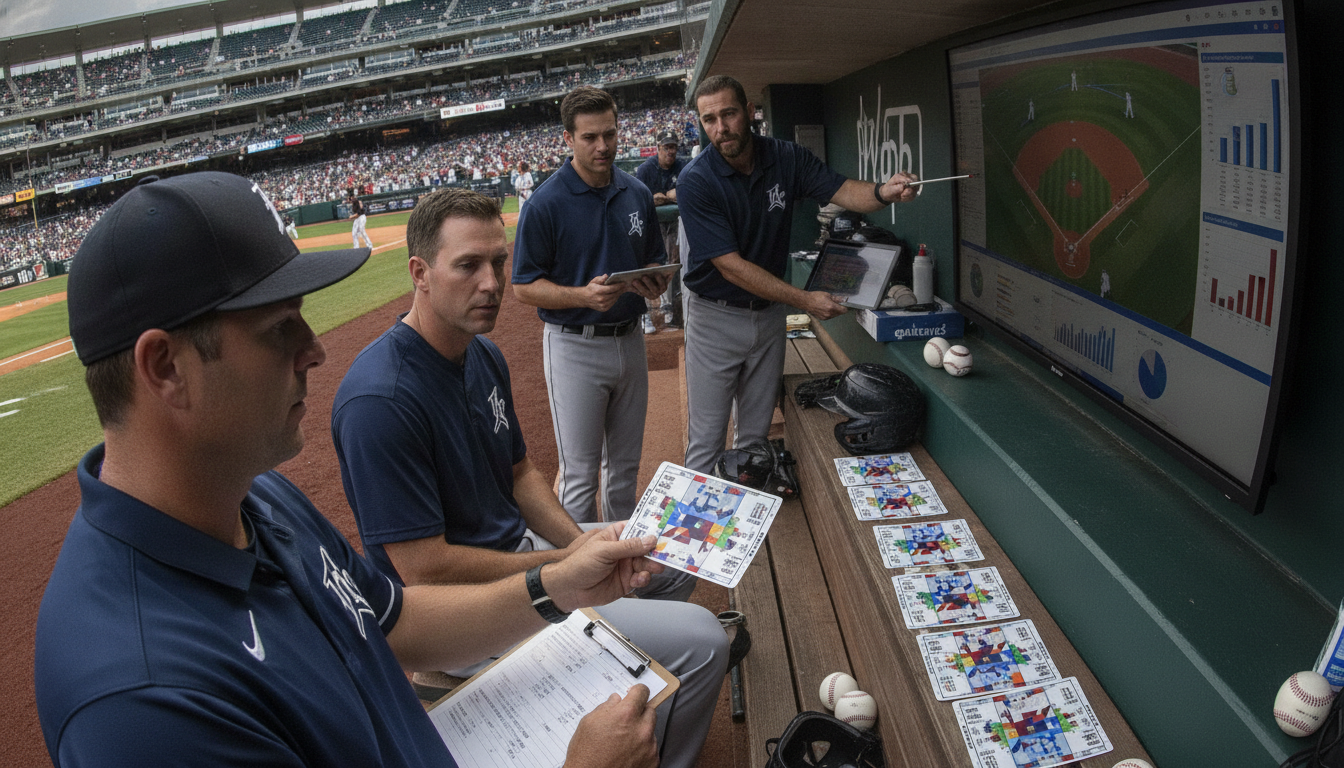
What Information Goes into MLB Defensive Positioning Cards?
Inside MLB defensive positioning cards: how teams use Statcast data, scouting notes, hitter tendencies and ballpark factors to set defenders and limit damage.
Major League Baseball clubs now rely on detailed MLB defensive positioning cards that synthesize Statcast metrics, scouting observation and situational factors to decide where fielders stand each game. These cards—part analytics dashboard, part scouting cheat sheet—translate hitter tendencies into precise alignment choices designed to convert batted balls into outs. The push toward data-driven defense has accelerated as teams seek marginal gains in a sport where a few feet can change outcomes.
Data Sources and Key Metrics
Teams draw first from Statcast, MLB’s high-resolution tracking system, which provides exit velocity, launch angle, and spray-angle maps for every hitter. Those metrics let analysts model where balls are most likely to travel and how often each zone yields outs for specific pitchers.
Supplementary analytics include catch probability grids, shift heat maps and batted-ball value metrics such as xBA and xwOBA. These statistics feed algorithms that recommend alignment adjustments down to inches, and they form the quantitative backbone of each defensive positioning card.
Scouting Notes and Player Habits
Analytics are paired with human scouting to account for subtleties statistics can miss, such as a hitter’s approach in two-strike counts or his tendency to pull on high fastballs. Coaches add notes on batter quirks, sprint speed differentials and whether a hitter crowds the plate or chokes up, which can affect routing and first-step decisions.
Individual defender profiles are also included: arm strength, range, reaction time and comfort with the ball in certain zones. Those attributes determine whether a team trusts, for example, a shortstop to shade deeper on a pull-heavy lefty or to play shallower with a weak-hitting contact batter at the plate.
Game Context and Situational Adjustments
Defensive positioning cards are situational tools that adjust for inning, score, baserunners and count. Teams will position differently with a runner on second and one out than they would in a bases-empty, early-inning plate appearance; the card contains pre-made sets for common scenarios.
Pitch selection and the pitcher’s own ground-ball or fly-ball tendencies also shape positioning. Cards integrate the planned pitch sequence so infielders and outfielders know where to anticipate contact, and they are updated in real time when a pitcher deviates from the script.
Ballpark and Environmental Considerations
Ballpark geometry is an explicit field on the card because dimensions and turf surfaces alter defensive risk. A shallow left field or quirky angles in foul territory will prompt distinct alignments, while slower artificial turf can influence how deep outfielders play.
Weather and visibility are noted as well; wind direction that favors balls carrying to right or left can shift a team’s alignment. These environment fields ensure cards are not generic but tailored to the exact conditions of each game.
Communication, Implementation and Accountability
Cards are delivered to players through layered channels: digital tablets in dugouts, laminated handouts and chalkboard reminders in pregame meetings. Managers and positioning coaches walk through recommended setups during innings, and catchers often relay micro-adjustments based on pitch calls.
Implementation relies on concise language and repetition; players see the same cues daily so alignment becomes instinctive. After plays, coaches review whether positioning achieved the intended outcome and feed performance back into the next iteration of the card.
Technology, Updates and Real-Time Revisions
Modern positioning cards are living documents updated between and during games. Teams use tablet apps that sync Statcast feeds and scouting inputs to push live revisions when a hitter changes approach or a pitcher drops off. This real-time capability has narrowed the gap between analysis and execution.
Automated alerts flag deviations from expected spray patterns and recommend counter-moves, but final decisions rest with coaches who weigh analytics against in-the-moment judgment. The interplay between algorithmic suggestions and human oversight is a central feature of contemporary defensive strategy.
Controversies, Competitive Edge and Rules
Shifts and aggressive positioning have sparked debate about the balance between offense and defense in MLB, and cards sit at the center of that conversation. Leagues and rulemakers have intermittently adjusted regulations on shifts, prompting teams to redesign cards and emphasize versatile defenders.
Beyond rule debates, positioning cards offer a competitive edge by turning marginal probabilities into measurable run prevention. Franchises with deeper analytics staffs or more granular scouting pipelines can exploit small advantages that, over a season, translate into more wins.
Teams view MLB defensive positioning cards as tools that combine science and experience to reduce offensive production by precise degrees. As tracking technology and machine learning models improve, the cards will incorporate even finer-grain inputs and grow more predictive.
Ultimately, the cards represent the sport’s evolving approach to defense: a systematic effort to turn data and observation into smarter alignments, sharper coaching cues and, crucially, more outs.
