
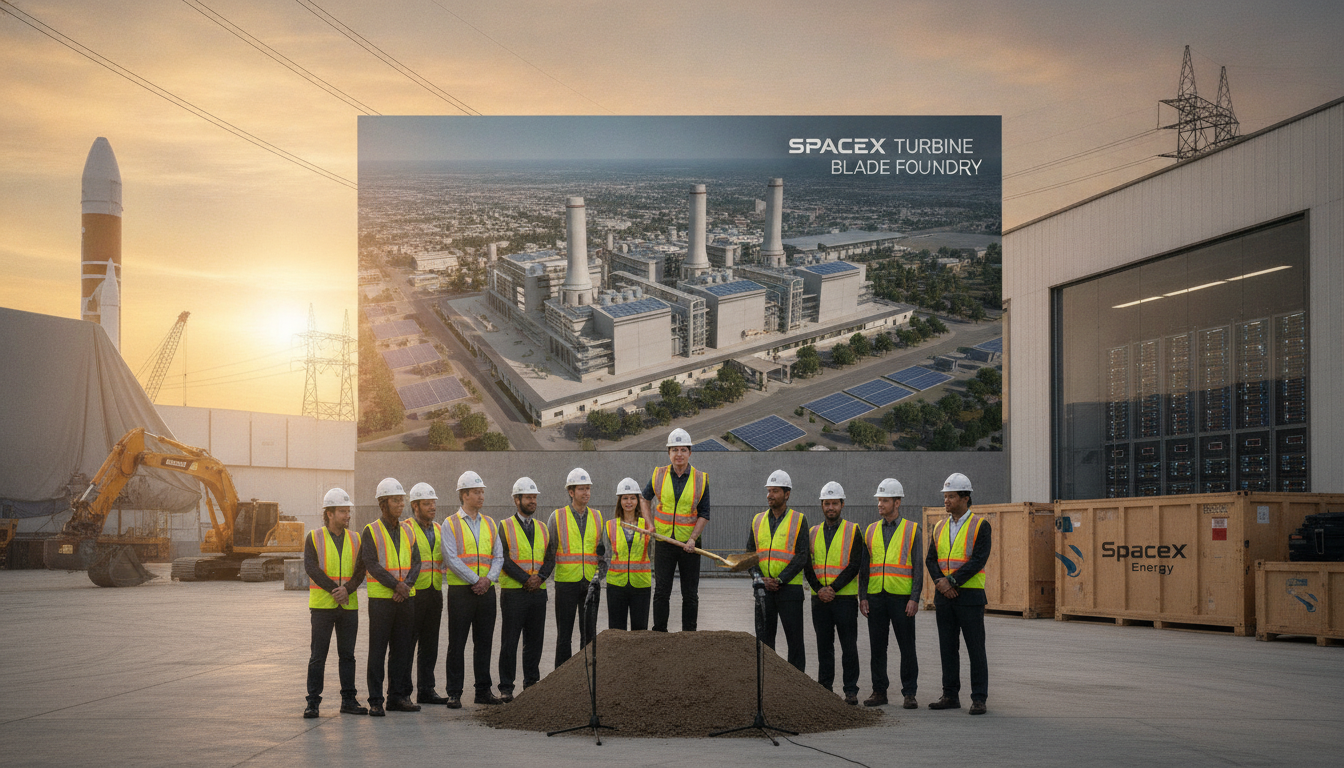
SpaceX turbine blade foundry in Bastrop to accelerate natural gas turbines for AI data centers
SpaceX turbine blade foundry in Bastrop will speed natural-gas turbine production for AI data centers, prompting industry shifts and pollution concerns.
Elon Musk confirmed that SpaceX is building a turbine blade foundry in Bastrop, Texas to cast the blades and vanes used in large natural gas turbines, a move intended to accelerate power generation for AI data centers. The announcement follows reporting that job listings and land purchases pointed to a blades-and-vanes foundry adjacent to SpaceX’s Starlink factory. Musk framed the effort as a way to shorten manufacturing timelines and help meet surging data center power demand.
Musk confirmation and facility details
SpaceX publicly acknowledged the Bastrop project after a report identified hiring notices and roughly 830 acres of newly acquired land near existing facilities. Company statements describe the site as a specialized foundry aimed at producing turbine blades and vanes in-house, an operation few suppliers currently perform at scale.
Musk has argued that tighter control of blade casting could speed natural gas turbine deployment by more than a year, and he tied the plan to broader energy moves at SpaceX and Tesla to scale solar production. The company did not release a detailed timeline for production or regulatory filings beyond employment and site acquisition disclosures.
Casting bottleneck and industry capacity
Manufacturers say the global supply of the high-performance blades used in the hottest sections of gas turbines is constrained by a complex, capital-intensive casting process. Only a handful of firms make single-crystal blades at industrial scale, and those suppliers report multi-year lead times amid rising demand.
Industry sources and reporting have highlighted that the bottleneck is not simply raw material availability but the technical capacity to cast large, defect-free blades and vanes. By establishing its own casting lines, SpaceX aims to bypass external queues and increase the pace at which new gas-fired plants can be built to serve data centers.
Why gas turbines matter to AI and data centers
Hyperscalers and AI operators are confronting two simultaneous constraints: access to compute hardware and reliable local power. With data center electricity consumption projected to grow substantially this decade, many companies are opting to deploy on-site natural gas turbines to ensure uninterrupted delivery while renewables scale up.
Major cloud and AI firms have adopted on-site generation strategies to avoid delays associated with grid expansion. This trend has pushed turbine makers to near-capacity bookings, prompting companies that rely on external suppliers to explore alternatives that shorten deployment lead times.
Technical demands of single-crystal blades
The blades used in the hottest stages of power turbines operate at temperatures far above the melting point of their base alloys, enabled by internal cooling channels, coatings, and the critical single-crystal casting method. Producing these components requires vacuum furnaces, slow crystal growth and processes that eliminate microscopic seams that cause cracking under thermal stress.
Scaling that process from jet-engine-size parts to the larger components used in stationary power plants increases difficulty, cost and defect risk. Achieving reliable yields at scale has been a barrier for new entrants and a reason why existing vendors have been overwhelmed by orders from data center and power customers.
Community and regulatory concerns over emissions
Deploying more gas-fired turbines to meet data center demand has prompted legal challenges and public health scrutiny in multiple U.S. communities. Civil-rights and local environmental groups have raised concerns about smog-forming compounds and hazardous pollutants emitted by turbines, citing potential impacts on respiratory disease and other health outcomes.
Cases under public review include allegations that some installations operated without required permits or adequate pollution controls, and academic and independent analyses have modeled broad population exposure and estimated health damages. Those findings underscore the tension between rapid infrastructure deployment and community-level environmental protections.
Strategic implications for AI infrastructure competition
If SpaceX successfully masters in-house casting at industrial scale, it would secure a manufacturing capability that is currently concentrated in a small number of suppliers, potentially giving SpaceX-controlled entities a timing advantage in powering large AI-focused data centers. That edge could shorten project schedules for companies that either partner with or are part of Musk’s ecosystem.
At the same time, expanding domestic casting capacity may relieve some industry-wide supply pressure and enable faster buildouts of on-site generation across providers. The practical effect will depend on regulatory approvals, production yields, and whether increased turbine deployment proceeds alongside robust emissions controls and community engagement.
The industry is likely to watch Bastrop closely for production milestones and permitting steps, as the outcome will influence how quickly operators can scale compute capacity while balancing environmental and public health considerations.
