
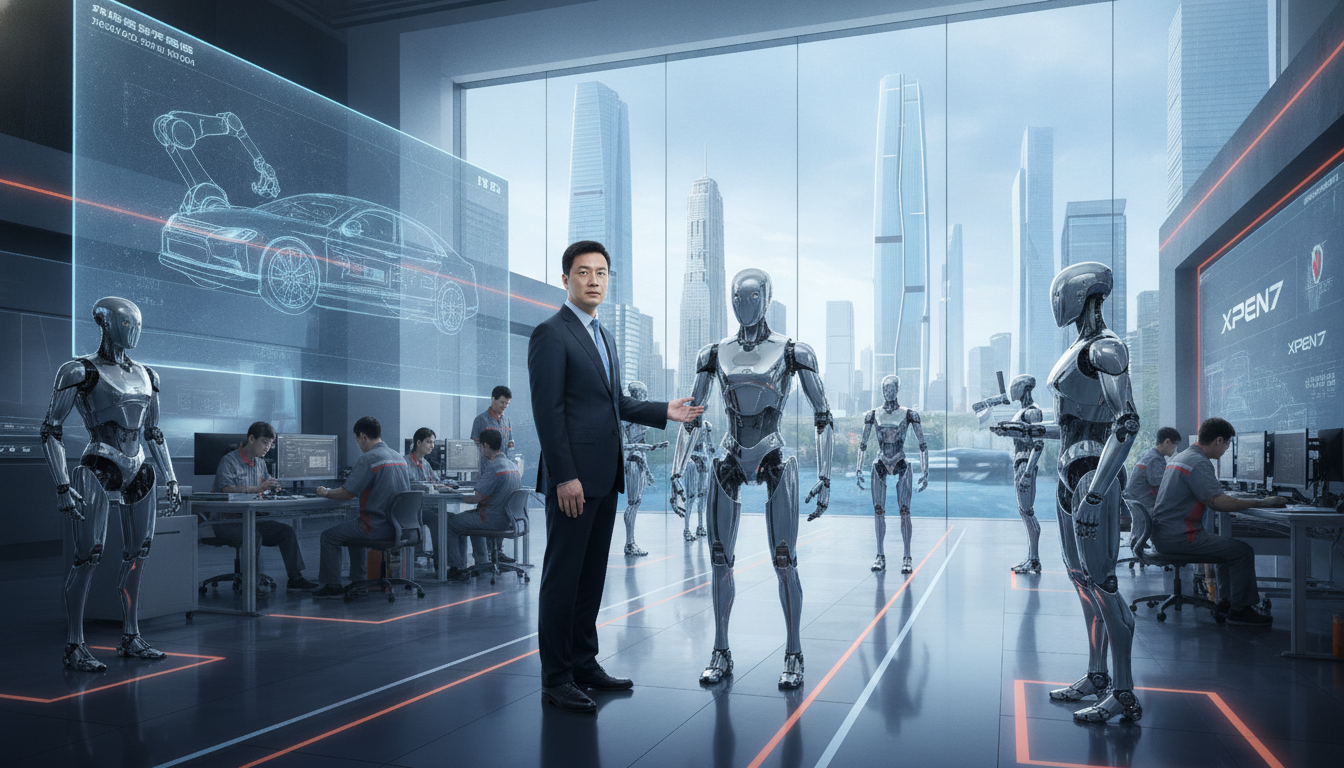
China’s automakers place heavyweight bets on humanoid robots as Xpeng leads a funding wave
Xpeng’s robotics unit raised over $900 million as Chinese automakers race to commercialize humanoid robots, leveraging manufacturing scale and fresh AI investments.
Xpeng’s robotics arm closed a blockbuster private financing round this week, joining a broader surge of investment and development in humanoid robots across China’s auto sector. The funding, led by major venture funds and backed by tech conglomerates, signals a shift in priorities for several carmakers that now view embodied AI and humanoid robots as a potential path to higher margins than increasingly competitive electric vehicles. Company leaders put personal capital behind the effort, underscoring how automakers are treating humanoid robots as a strategic, long-term bet rather than an experimental sideline.
Xpeng Raises More Than $900 Million for Iron Humanoid Unit
Xpeng’s robotics unit announced a financing round valued at more than $6.3 billion post-money, with the company saying the round exceeded $900 million. The investment was led by established China-focused funds and attracted participation from large technology groups, highlighting investor appetite for “embodied AI” built into physical machines. Xpeng founders also personally invested significant sums, illustrating management confidence in the business case for humanoid robots.
Several Chinese automakers accelerate humanoid robot programs
A growing list of Chinese carmakers have disclosed humanoid or general robotics initiatives in recent months, ranging from prototype reveals to preparations for public listings. Companies including Chery’s robotics affiliate, BYD, Changan, GAC, Li Auto, SAIC, and others are advancing designs or corporate plans tied to humanoid or service robots. Industry observers say this clustering reflects both competitive imitation and a belief that auto manufacturing capabilities can reduce hardware costs for humanoid production.
Manufacturing scale gives Chinese automakers an edge, but AI remains pivotal
Automakers bring deep experience in supply chains, mass production and hardware integration, which can shorten the path from research to deployed robots. That manufacturing advantage, however, must be paired with breakthroughs in perception, motion planning and generalization that come from advanced AI systems. Experts note that catching competitors who have led in machine learning integration will require significant software investment and talent recruitment in addition to factory know-how.
Global competitors and strategic acquisitions expand the field
The humanoid robot landscape is increasingly international, with startups and established industrial players pursuing commercial use cases in logistics, manufacturing and services. Western robotics firms and other automakers are simultaneously moving toward deployment, while suppliers and tech companies have pursued acquisitions to secure robotics capabilities. Recent corporate moves underscore how automakers and suppliers are hedging bets by acquiring software and systems expertise to accelerate product readiness.
Pilots and factory integration define near-term deployment plans
Several deployments now cited by industry participants target factory assistance and parts handling as initial use cases for humanoid robots, where repetitive tasks can justify early investment. Automotive groups have outlined pilots to teach robots specific sequences of movement, such as lifts and turns, with the intention of scaling to routine factory tasks over the next few years. These plans reflect a pragmatic approach: demonstrate reliability in constrained environments before expanding to broader commercial roles.
Profitability and time horizon for commercial humanoid robots remain uncertain
Carmakers point to slim margins in vehicle sales and see higher potential returns in robotics software licensing, services and data-driven products tied to embodied AI. Investors, however, will be watching development costs, unit economics and the pace of real-world validation closely before awarding premium valuations. Regulatory and safety hurdles, standards for human-robot interaction, and the challenge of general-purpose learning in varied environments will all shape how quickly the market matures.
The rush among Chinese automakers to join the humanoid robot market represents a notable pivot in the industry’s posture toward AI-driven physical systems. If manufacturing strengths combine with robust AI and careful deployment strategies, humanoid robots could move from demonstrations into routine commercial work over the coming years. For now, the real test will be whether these companies can convert engineering progress and large rounds of capital into reliable, scalable products that deliver sustainable revenue streams.
