
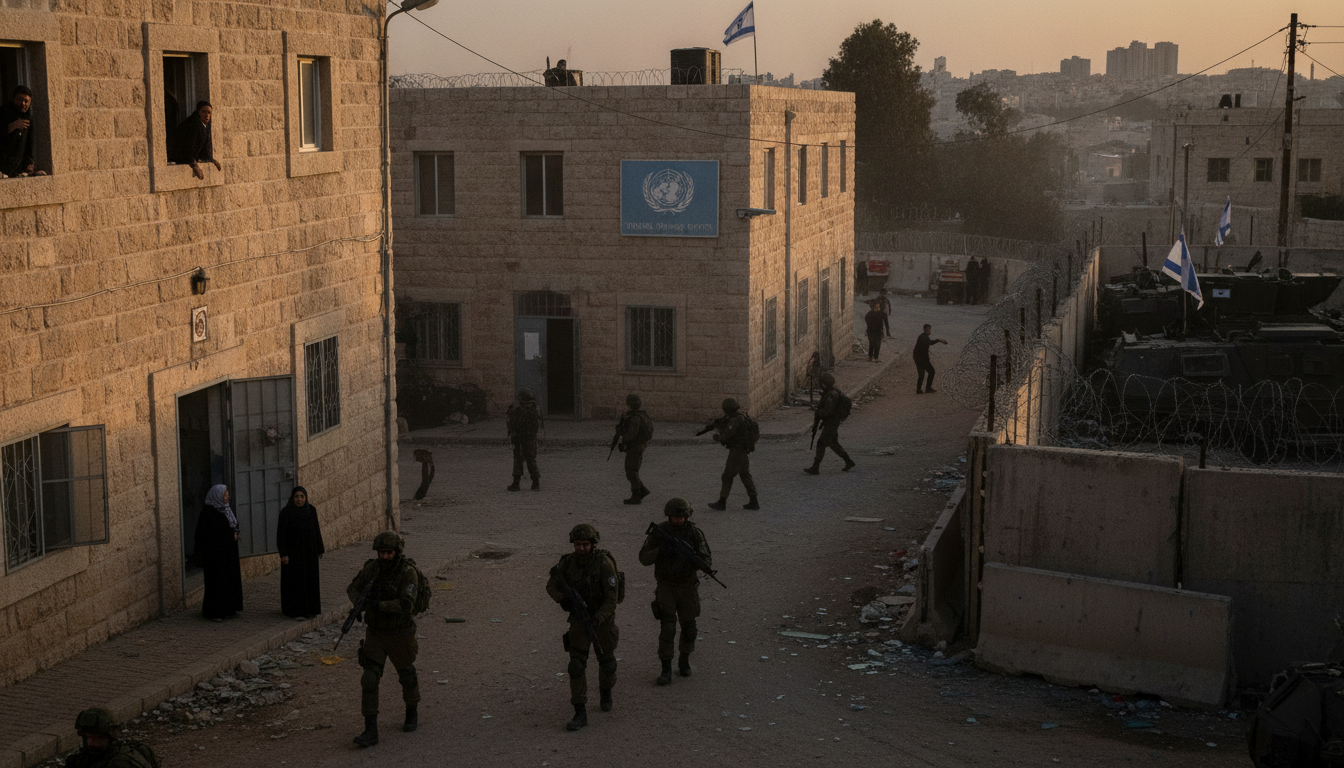
Israeli forces raid UNRWA Qalandiya training centre in East Jerusalem amid wider territorial push
Israeli forces stormed the UNRWA Qalandiya training centre, raising international alarm over refugee protections and signalling broader plans to reshape West Bank territorial control.
Israeli forces on Tuesday raided the United Nations Relief and Works Agency (UNRWA) training centre in Qalandiya, on the boundary between occupied East Jerusalem and the West Bank, in an operation officials said was led by National Security Minister Itamar Ben-Gvir. The Qalandiya raid, justified by an Israeli law passed in October 2024 that bans UNRWA, involved the lowering of the agency’s flag and seizure of the compound, UNRWA representatives and analysts said. The action drew immediate condemnation from Qatar and prompted warnings that the move could dismantle long-standing international protections for Palestinian refugees.
Israeli forces storm UNRWA Qalandiya complex
Israeli officials described the operation as enforcement of the October 2024 legislation that bars UNRWA activity, while UNRWA says it received no prior notice before the takeover. UNRWA media adviser Adnan Abu Hasna called the seizure unprecedented, saying the lowering of the UN flag and the occupation of agency headquarters violated agreements and international humanitarian norms.
Agency officials said the Qalandiya complex provided training, education and community services, and that its seizure compounds a longer pattern of raids, destruction of UN compounds and operational restrictions. UNRWA also faces a severe funding shortfall driven in part by political defunding campaigns, including significant cuts in recent U.S. funding, the agency warned.
Government cites October 2024 UNRWA ban
Israeli authorities invoked the October 2024 law that moved to ban UNRWA operations in parts of the occupied territories as the legal basis for the incursion. The law, introduced amid assertions by some Israeli officials about security concerns, has been criticised by diplomatic actors and humanitarian organisations as undermining protections for civilian services.
Legal and humanitarian experts say the unilateral move to apply domestic legislation to UN operations in occupied territory raises complex questions about the protection of international personnel and facilities. UNRWA officials point to an agreement signed on June 14, 1967, that previously obliged Israel to facilitate and protect agency operations, and say that those guarantees have been abandoned.
UNRWA warns of service collapse for refugees
UNRWA personnel and local community leaders warned that the Qalandiya raid could accelerate the erosion of basic services for millions of Palestinian refugees who rely on the agency for education, health care and social support. Adnan Abu Hasna said the measure represents a dangerous escalation against UN law and the agency’s mandate from the UN General Assembly.
Beyond immediate service disruption, UNRWA has signalled that repeated seizures and funding shortfalls threaten the agency’s long-term capacity to operate schools, clinics and microfinance programmes across the West Bank and Gaza. The agency’s declining resources amplify fears that refugees will lose access to essential services at a time of growing humanitarian need.
Settlement plans and territorial ambitions
Several analysts tied the Qalandiya raid to broader territorial ambitions in and around East Jerusalem, arguing the operation is part of a concerted effort to consolidate control over contiguous land. Israeli affairs expert Adel Shadid said the training centre sits adjacent to the historic Qalandiya airport and that control over both sites would enable a major settlement project and the annexation of territory into a “Greater Jerusalem” scheme.
Shadid estimated such an expansion could carve out between 12 and 13 percent of the West Bank and frustrate any future contiguous Palestinian state, a claim echoed by other regional analysts. Retired military figures and commentators also warned that seizing key nodes of infrastructure and territory would further fragment Palestinian urban continuity between Jerusalem and Ramallah.
State-settler security integration on display
Local analysts described the operation as showing an increasing integration between Israeli state security forces and armed settler groups. Anas Abu Arqoub characterised the settler phenomenon as organised, with hierarchical leadership and access to military training and weapons, and said that the lines between official forces and settler militias have blurred.
Research institutions in Israel have signalled concern over this convergence, noting that armed settler networks operating with tacit or explicit state tolerance can magnify the risk of wider violence and displacement. Observers warned that the growing role of such groups in operations around Palestinian population centres raises the stakes for civilian protection.
International responses and political fallout
Qatar swiftly condemned the raid and framed it as part of systematic efforts to strip Palestinians of services and rights, while UNRWA and other diplomatic actors called for the restoration of agency protections and access. Regional and international governments face renewed pressure to respond to the application of domestic bans on a UN agency active for decades in Palestinian refugee affairs.
Birzeit University political scientist Ghassan Khatib pointed to the international context, saying the perceived U.S. position in recent years has emboldened Israeli policy shifts and reduced the deterrent effect of multilateral institutions. Analysts say the diplomatic fallout is likely to center on humanitarian access, funding decisions and whether international bodies can secure the protection of UN premises and personnel.
Local residents reported alarm and resistance in Qalandiya, where community leaders described the raid as an expression of political messaging as much as a security operation. Mohammed Saeed, a representative of the Qalandiya refugee camp committee, said the incursion was intended to signal determination over land and governance.
The Qalandiya raid has thus opened a new front in an already fraught arena of occupation policy, refugee protections and territorial politics; whether the seizure of the UNRWA complex becomes a turning point in access to refugee services or a further step toward territorial consolidation will depend on responses from international bodies, donor states and the ground dynamics that follow.
