
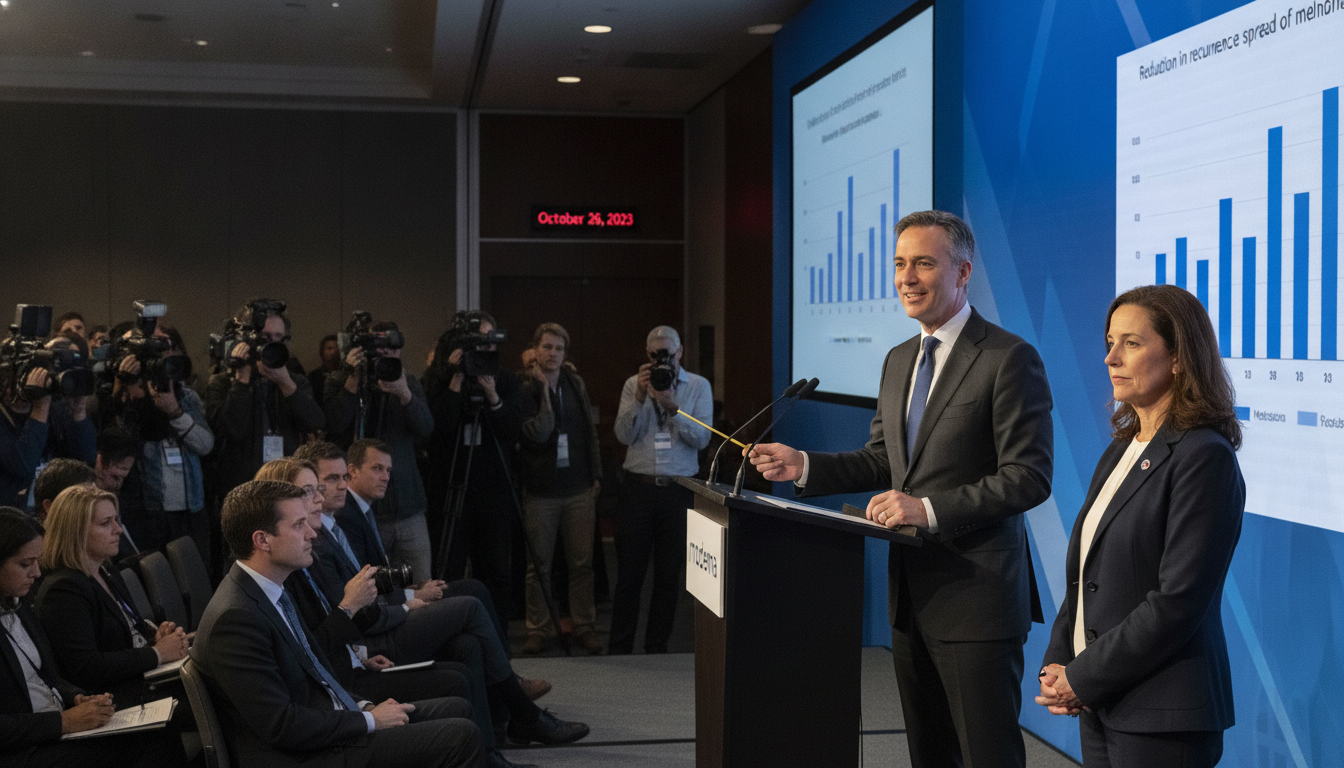
Moderna’s Intismeran mRNA cancer vaccine cuts melanoma recurrence and spread in late-stage trial
Moderna and Merck report Intismeran reduced melanoma recurrence and metastasis in a late-stage trial; regulators are already in talks about potential approvals.
Moderna and Merck report positive Intismeran trial results
Moderna and Merck said interim data from a late-stage trial show Intismeran, a personalised mRNA cancer vaccine, reduced the risk of melanoma returning and of tumours spreading. The companies announced the findings on 19 August 2026, saying the treatment met both of its primary goals in the analysis.
The result marks the first positive late-stage outcome for an mRNA cancer vaccine, the companies said, and sent Moderna’s shares sharply higher after the announcement. Detailed efficacy and safety figures were not released immediately but are expected to be presented at an upcoming medical meeting.
Interim data show reduced recurrence and spread
According to the companies, the interim readout demonstrated statistically significant reductions in both recurrence and metastatic progression among patients treated with the vaccine plus standard immunotherapy. The trial evaluated people with high-risk melanoma who had undergone surgical removal of their tumours and were at elevated risk of relapse.
Moderna and Merck said the analysis met both of the study’s prespecified endpoints, a milestone that typically triggers more intensive regulatory discussions and planning for possible approval submissions. The drugmakers have not yet provided the full breakdown of subgroup results, duration of follow-up, or safety signals.
How Intismeran trains the immune system
Intismeran is a personalised immunotherapy built on mRNA technology that encodes tumour-specific mutations identified from each patient’s cancer. The vaccine is designed to prompt the immune system to recognise those unique mutations and target residual cancer cells that could otherwise cause recurrence.
In this trial the vaccine was administered alongside Merck’s immunotherapy drug pembrolizumab, marketed as Keytruda, with the intention of amplifying the immune response. Researchers have been exploring mRNA approaches in oncology by pairing personalised vaccines with checkpoint inhibitors to both widen and strengthen anti-tumour immunity.
Regulatory talks and timeline toward approval
Moderna said it and Merck are already in discussions with regulators following the interim results, and company executives indicated a possible path toward approval if confirmatory data remain favorable. Moderna President Stephen Hoge suggested that, with regulatory approvals, thousands of patients who have had high-risk melanoma surgically removed could be treated as early as 2027.
Regulatory authorities will require the full dataset, including safety information and longer follow-up, before decisions can be made. The companies said they plan to present detailed results at a forthcoming scientific meeting, after which formal submissions to agencies such as the U.S. Food and Drug Administration and its counterparts in other jurisdictions could follow.
Experts highlight potential impact for solid tumours
Cancer researchers and advocates described the finding as an important step for mRNA-based oncology, with some calling it the start of a new phase in immunotherapy. Karen Knudsen, chief executive of the Parker Institute for Cancer Immunotherapy, said the outcome points to broader possibilities for treating solid tumours with personalised vaccines.
Observers cautioned that interim results, while encouraging, require verification through continued follow-up and peer-reviewed publication. They noted that success in melanoma — a tumour type already responsive to immune-based therapies — does not guarantee the same benefit in cancers that are less immunogenic, though it opens a promising avenue for further trials.
Clinical scale and implications for patients
If regulators grant approval, the approach would be deployed in patients identified as high risk of recurrence following surgery, potentially changing standard care for that population. Data cited by the drugmakers and health institutes underline the burden of melanoma; for instance, U.S. estimates indicated more than 1.5 million people were living with melanoma in 2023, underscoring a substantial potential pool of beneficiaries.
Manufacturing and logistics will be central to scaling a personalised mRNA vaccine, because Intismeran requires tumour sequencing, bespoke vaccine production and coordination with systemic immunotherapy. Companies and health systems will face challenges in ensuring timely turnaround from tumour profiling to vaccine delivery, especially if broader approval is pursued.
The companies said detailed trial data will be shared with the medical community at an upcoming scientific meeting, where investigators will provide the full efficacy and safety analyses and discuss implications for clinical practice. Observers will watch those presentations closely for information on durability of benefit, adverse events and which patient subgroups derived the greatest advantage.
