
Britain’s terrorism laws under scrutiny after Palestine Action proscription and court rulings
Britain’s terrorism laws face renewed scrutiny as the government’s proscription of Palestine Action and subsequent court rulings expand what counts as terrorism, sparking mass arrests and legal challenges.
Court of Appeal upholds proscription
The Court of Appeal on June 15, 2026, reversed a lower-court judgment and upheld the government’s decision to proscribe Palestine Action under the Terrorism Act 2000. The appeal court dismissed an earlier Divisional Court finding from February 2026 that had ruled the ban unlawful, deepening a high-profile legal dispute over the scope of counter-terrorism powers.
In its judgment the Court of Appeal described the group as operating covertly in cells, a characterization that has itself become contested in public debate. That assessment and the ultimate decision to sustain the ban have prompted fresh challenges on whether the law is being applied to protest activity rather than to violence intended to terrify the public.
How the legal definition of terrorism is written
Under Section 1 of the Terrorism Act 2000, acts can be designated as terrorism if they involve property damage carried out for a political, religious, racial or ideological purpose and are intended to influence government or intimidate the public. The statute is broader than common usage of the word “terrorism” and allows non-violent conduct to fall within terrorism legislation where a political purpose is established.
That breadth has alarmed legal commentators and some judges in the past, who warned the definition is “very far‑reaching” and risks capturing a wide range of politically motivated conduct. Critics argue that stretching the definition to include property damage transforms ordinary protest and direct action into offences that attract exceptional powers.
Proscription as a political instrument
Proscription is not a neutral legal process but a political choice that criminalizes membership and public support for designated organisations. Governments decide which organisations are banned, and that discretion has produced inconsistencies: groups with similar characteristics can be treated differently depending on geopolitical context and alliances.
Past examples underline this asymmetry. The UK has proscribed some armed groups while declining to proscribe actors that became partners in conflicts against common enemies. The 2021 extension of the proscription to include the entirety of Hamas, rather than only its armed wing, exemplifies how a political decision can collapse distinctions between political and military structures and expand criminal liability for civilians associated with proscribed organisations.
Impact on protesters and arrest figures
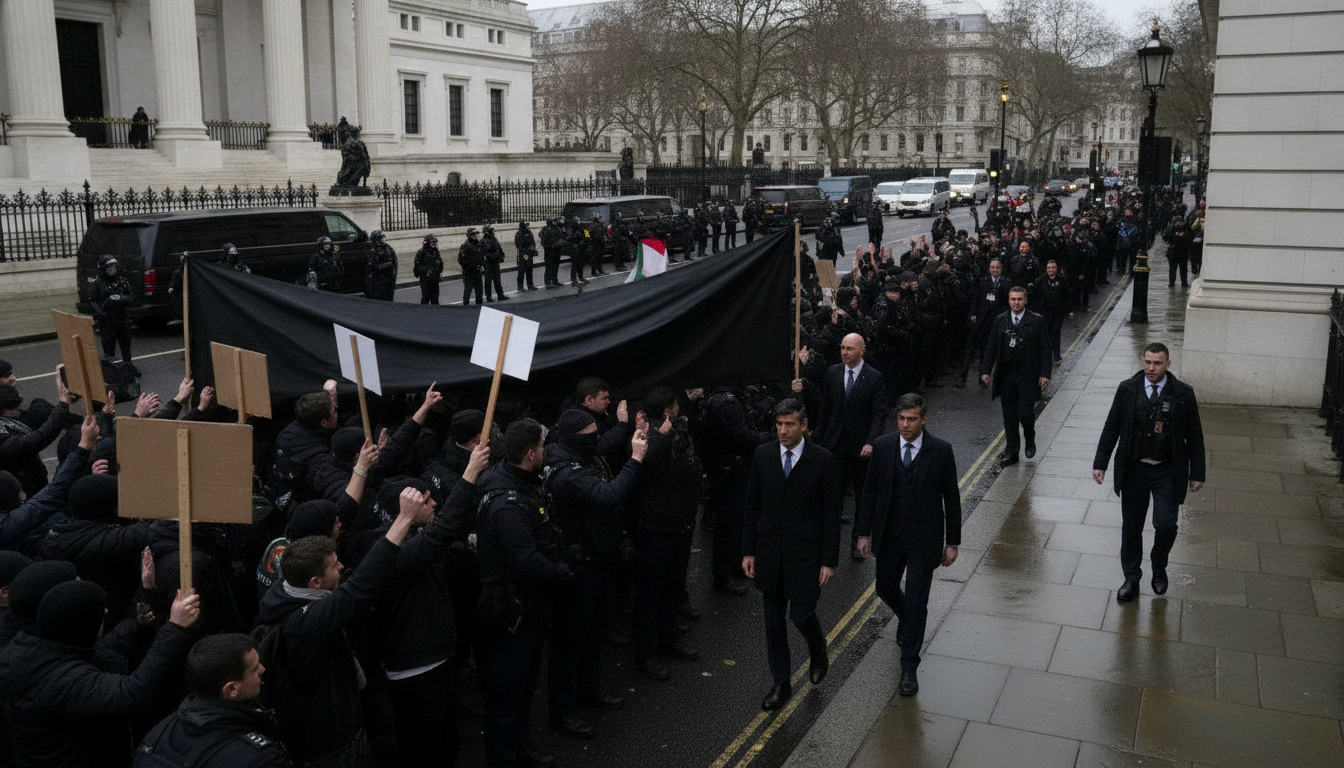
The proscription of Palestine Action has had immediate criminal justice consequences. Authorities report thousands of arrests linked to suspected support for the group, many arising from demonstrations and the display of placards. Official figures for the year ending March 2026 showed a significant share of terrorism-related arrests were connected to alleged support for Palestine Action, reshaping the profile of those drawn into counter-terrorism enforcement.
Demographic data cited by the Home Office indicate the majority of those arrested in connection with Palestine Action were older and disproportionately women, a pattern that has surprised some commentators. Human rights officials, including the UN’s rights office, have warned that applying counter-terrorism legislation to protest activity risks chilling legitimate political expression and may be inconsistent with international rights obligations.
Trials, verdicts and contested courtroom rulings
Cases arising from direct action against military suppliers have produced mixed jury outcomes and contentious judicial rulings. In one prominent example, defendants accused of damaging an arms manufacturer faced lengthy pre-trial detention and a jury acquitted on the most serious charges at the first trial, with mixed results at a later retrial. Sentencing considerations later treated offences as having a “terrorist connection,” a finding that affected penalties and was criticized by defence lawyers.
Judges have also limited certain legal defences in these cases, including arguments that actions were necessary to prevent a greater crime. That narrowing of the permissible legal arguments has prompted debate about the proper role of juries and the balance between public order and political protest in criminal trials.
Historical context and comparisons with past protest movements
Some legal defenders of the proscription have contrasted contemporary direct action with historical civil disobedience, citing movements such as the suffragettes as examples of open, transparent protest. Historians and legal critics point out that early 20th‑century suffrage campaigns included episodes of property damage, targeted attacks and clandestine actions that by modern statutory definitions could be captured by terrorism legislation.
The comparison has been used on both sides of the debate to argue for either restraint in applying counter‑terrorism powers or for firm policing of disruptive tactics. The historical record complicates simple distinctions between lawful protest and actions that contemporary law now classifies as terrorism.
Ongoing legal battles and wider implications
The dispute over Palestine Action’s proscription has spawned multiple legal challenges and attracted international attention, from rights bodies to legal commentators. The author of a recent critical analysis of the proscription has publicly said their own trial on related charges has begun, illustrating how the legal and personal consequences of the government’s decision extend beyond organisational bans to prosecutions of individuals.
As appeals and judicial reviews continue, Britain’s terrorism laws remain under close scrutiny for their reach and consequences. The tension between combating genuine threats and protecting the space for protest presents a continuing test for courts, legislators and civil society as the country grapples with how to define and prosecute terrorism without eroding political freedoms.
