
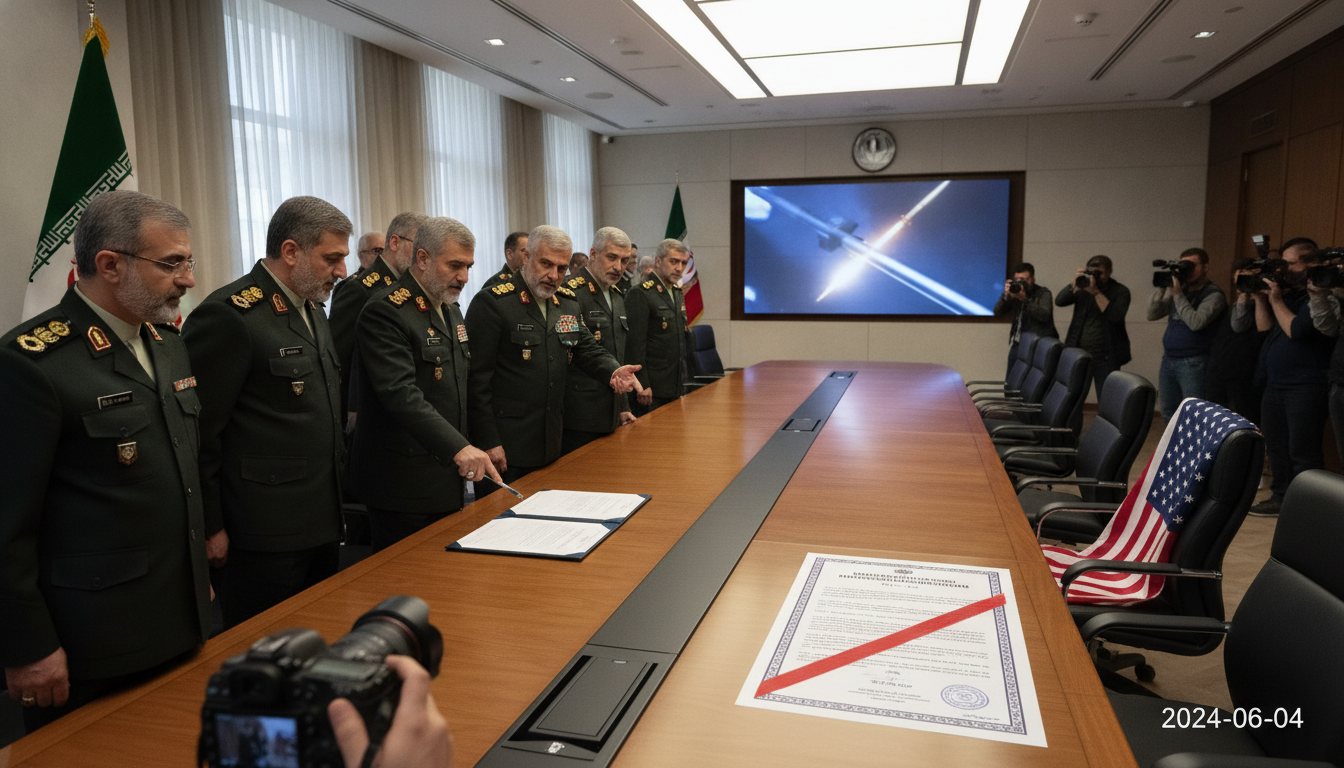
Iran signals offensive posture as June MoU with U.S. expires
Iran warns of potential offensive action as the June memorandum of understanding with the U.S. expires, raising tensions over the Strait of Hormuz and regional security.
Iranian commanders signalled a possible shift toward offensive operations on Monday after the memorandum of understanding (MoU) with Washington formally expired, increasing concerns about the future of the conflict and the security of the Strait of Hormuz. The MoU expiry was cited by senior Islamic Revolutionary Guard Corps (IRGC) officials as removing a diplomatic constraint that had underpinned a fragile ceasefire reached in June. Tehran’s statements, made publicly by IRGC political chief Brigadier General Yadollah Javani and other senior figures, framed the change as a defensive escalation that could adopt offensive elements.
IRGC signals shift in strategy
Brigadier General Yadollah Javani told state media the IRGC is ready to take whatever measures are required to defend the nation now that the MoU expires. He described the previous period as largely defensive but said Iran’s posture could evolve, warning opponents to expect “strategic surprises.” Those remarks mark an explicit broadening of the language used by Tehran’s military leadership since the June agreement.
IRGC spokespeople and allied officials emphasised that any escalation would be carefully calibrated and presented as retaliatory or preventative. The change in tone comes after fighting resumed last month, a development Iranian authorities say weakened the practical effect of the June accord even before its formal end.
Targets and threats outlined by commanders
Senior IRGC figures have identified critical infrastructure as potential targets if Iran’s civilian systems are struck, naming energy networks, power plants and internet-linked systems in public statements. Spokesman Hossein Mohebbi specifically cited such infrastructure as vulnerable, framing attacks on civilian installations as a red line that could prompt wider responses. Analysts caution that targeting infrastructure carries high risks of escalation and significant human and economic costs.
Hardline politicians and state-aligned media have also debated the prospect of operations beyond Iranian territory, including suggestions of ground moves against U.S. interests in the Gulf. Those proposals have been described by some Iranian commanders as contingent and strategically constrained, while outside analysts question their feasibility given logistical challenges and the scale of forces that would be required.
Leadership changes and doctrine under Supreme Leader
The military rhetoric follows a consolidation of power around Supreme Leader Mojtaba Khamenei, who has advanced trusted IRGC figures into key posts in recent days. Khamenei’s appointments were accompanied by calls for “maximum deterrence” combined with readiness for strong offensive operations from new commanders, a mix that signals a tougher national-security doctrine. Major General Ahmad Vahidi’s elevation to commander-in-chief of the IRGC was explicitly linked by state sources to a posture that blends deterrence with offensive capability.
Mohsen Rezaee, now occupying a senior national security role, publicly argued that prior U.S. strikes and naval actions have failed to achieve strategic objectives and that Iran has adapted its defense and response planning. Iranian officials portrayed the reshuffle as aligning political and military leadership for sustained confrontation if necessary.
U.S. rhetoric and naval posture draw reaction
Comments from U.S. officials and public rhetoric have intensified the standoff, with Tehran referencing provocative remarks and sustained carrier and naval deployments in the region. The United States has maintained a visible maritime presence near the Strait of Hormuz, and both sides have traded accusations over control of the waterway. Tehran says the strait will only fully reopen when Washington implements commitments it believes were agreed in the June MoU.
U.S. statements characterising their operations and goals have been met by Iranian counterclaims that the American strategy aims to control chokepoints and exert pressure on Tehran. While Washington has not signalled an imminent ground invasion of Iran, the U.S. naval posture and public comments have been cited by Iranian leaders as factors justifying tougher defensive and offensive planning.
Reinforcements and defensive preparations around Hormuz
Iranian military sources report bolstering rapid-response units, coastal defenses and island garrisons in southern provinces bordering the Strait of Hormuz. Officials say preparations include fortifying critical oil export terminals and installing measures to protect islands and maritime facilities from potential seizure or interdiction. Commanders insist these steps are intended to deny any foreign force an easy foothold on Iranian territory or key infrastructure.
Military spokespeople also emphasised contingency planning for unrest along Iran’s western and eastern frontiers, noting concerns about separatist activity and cross-border armed groups. The IRGC has continued targeted strikes on armed elements in neighbouring territories that Tehran regards as threats to its southern and western approaches.
Diplomacy, regional actors and the path ahead
Despite the MoU expiry, Iranian officials say parallel talks — notably with Oman over partial reopening of the strait — remain active but complex, hindered by legal and technical challenges and multiple stakeholders. Tehran’s foreign ministry characterised the two-month window surrounding the June agreement as not explicitly specified in the text and downplayed the formal expiration as the sole driver of policy decisions. Still, diplomats warn that the public hardening of rhetoric reduces space for rapid de-escalation.
Regional governments and international shipping interests are monitoring developments closely, as any widening of hostilities would threaten global energy supplies and commercial transit through the Hormuz corridor. Observers say that while Iran’s declarations increase uncertainty, real-world military moves and international responses will determine whether the situation stabilises or deteriorates further.
The expiration of the MoU has, at minimum, removed a diplomatic stopgap that had limited direct confrontation, and Tehran’s leaders now face a choice between sustained negotiation and a more confrontational strategy that could reshape security calculations across the Gulf.
Iran’s next steps — whether narrowly calibrated deterrence, targeted asymmetric strikes, or an effort to translate rhetoric into broader military action — will be watched closely by capitals across the region and by Ottawa as it assesses risks to commercial shipping and Canadian interests.
