
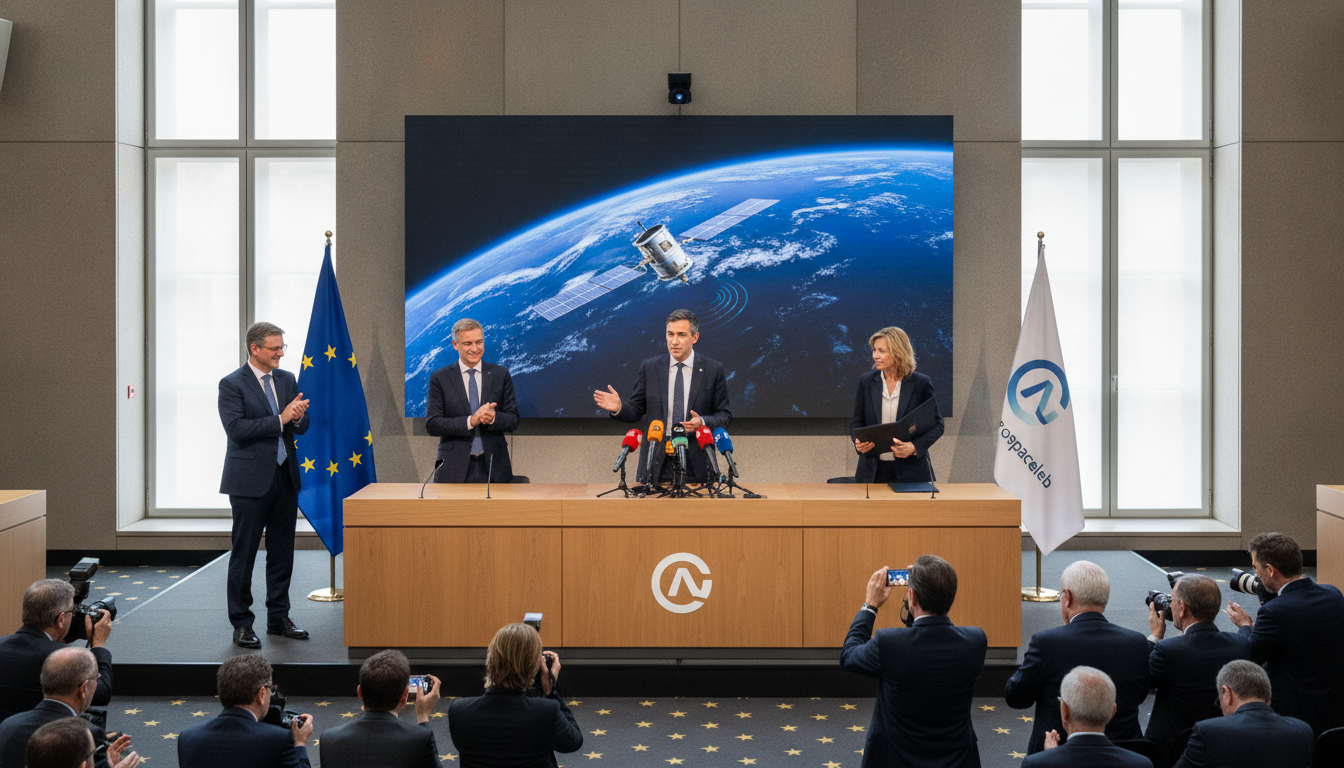
Aerospacelab Wins €1.8 Billion Deal to Build Up to 264 LEO Satellites
Belgian startup Aerospacelab will build up to 264 low-Earth-orbit (LEO) satellites as part of a 348-satellite program under a contract valued at least €1.8 billion, a move that will test the company’s manufacturing scale. Founded in 2018, Aerospacelab faces the task of delivering a large number of technically complex spacecraft in a compressed timeframe. The agreement positions the company at the center of a rapidly expanding market for LEO constellations while raising questions about production capacity and supply-chain resilience. Observers say the deal could reshape Belgium’s role in the European space industrial base.
Contract Details and Scale
The order calls for Aerospacelab to construct as many as 264 of the total 348 satellites in the constellation, establishing it as the main supplier in the program. The contract is reported to be worth a minimum of €1.8 billion, underscoring the commercial and strategic weight of the assignment. For a company launched in 2018, securing a deal of this magnitude marks a swift ascent from start-up status to major program supplier. The scope implies sustained production activity over multiple years and a steady pipeline of subsystems, test facilities and integration work.
Manufacturing and Ramp-Up Challenges
Meeting the delivery schedule will require Aerospacelab to rapidly scale manufacturing lines, hire and train specialized staff, and expand test infrastructure. Producing hundreds of satellites demands repeatable assembly procedures, rigorous quality control and efficient supply-chain management to avoid bottlenecks. The company will need to coordinate component sourcing, electronic subsystems, propulsion units and payload integration to maintain throughput. Any delays in part deliveries or testing capacity could cascade, affecting launch slots and the overall deployment timeline.
Technical Complexity of LEO Satellites
Although LEO satellites are typically smaller than geostationary platforms, they remain technologically sophisticated with demanding thermal, power and communications requirements. Each unit must withstand launch loads, operate reliably in a harsh orbital environment, and meet mission-specific payload specifications. Integration and environmental testing — including vibration, thermal vacuum and electromagnetic compatibility checks — are essential for flight readiness. Scaling those test campaigns from tens to hundreds of units elevates logistical complexity and increases the need for automated test benches and streamlined verification procedures.
Launch Logistics and Deployment Cadence
A program of this size implies a high cadence of launches to place the constellation into its required orbital planes on schedule. Coordinating manifest slots with launch providers, arranging rideshares and ensuring payload integration windows are met will become central program tasks. Frequent launches also mean the manufacturer must synchronize production batches with launch timelines and rapidly process post-delivery spacecraft for deployment. Efficient packing, transport and final on-site checks at integration facilities will be critical to avoid costly slip-ups before lift-off.
Market Impact and Competitive Context
The deal underscores growing commercial demand for LEO constellations, driven by broadband connectivity, Earth observation and data services. Aerospacelab’s sizable role could strengthen its negotiating position with suppliers and partners while encouraging investment in European small-satellite capabilities. Competitors and national space agencies will be watching closely, as the procurement highlights how private companies are increasingly shouldering large portions of constellation development. The agreement may also catalyze regional industrial activity, pulling in subcontractors across avionics, optics and manufacturing services.
Risks, Oversight and Contingency Planning
Large-scale satellite procurement brings technical, financial and programmatic risks that require robust mitigation strategies. The company and its contracting partner will need clear milestones, performance metrics and contractual protections to address delays or underperformance. Insurance arrangements, redundancy in key suppliers and contingency inventory will be important to preserve schedule resilience. Regulatory and orbital-debris considerations add further constraints, as increased launch activity and on-orbit operations must comply with national and international rules.
Aerospacelab’s selection as the primary builder for the majority of the constellation represents a defining moment for the young company and for the broader European small-satellite industry. Delivering hundreds of mission-ready LEO satellites will demand sustained investment in factories, workforce training and test infrastructure alongside tightly managed logistics and supplier networks. Success could accelerate the company’s growth and boost Belgium’s profile in space manufacturing, while setbacks would carry financial and reputational consequences for all parties involved.
