
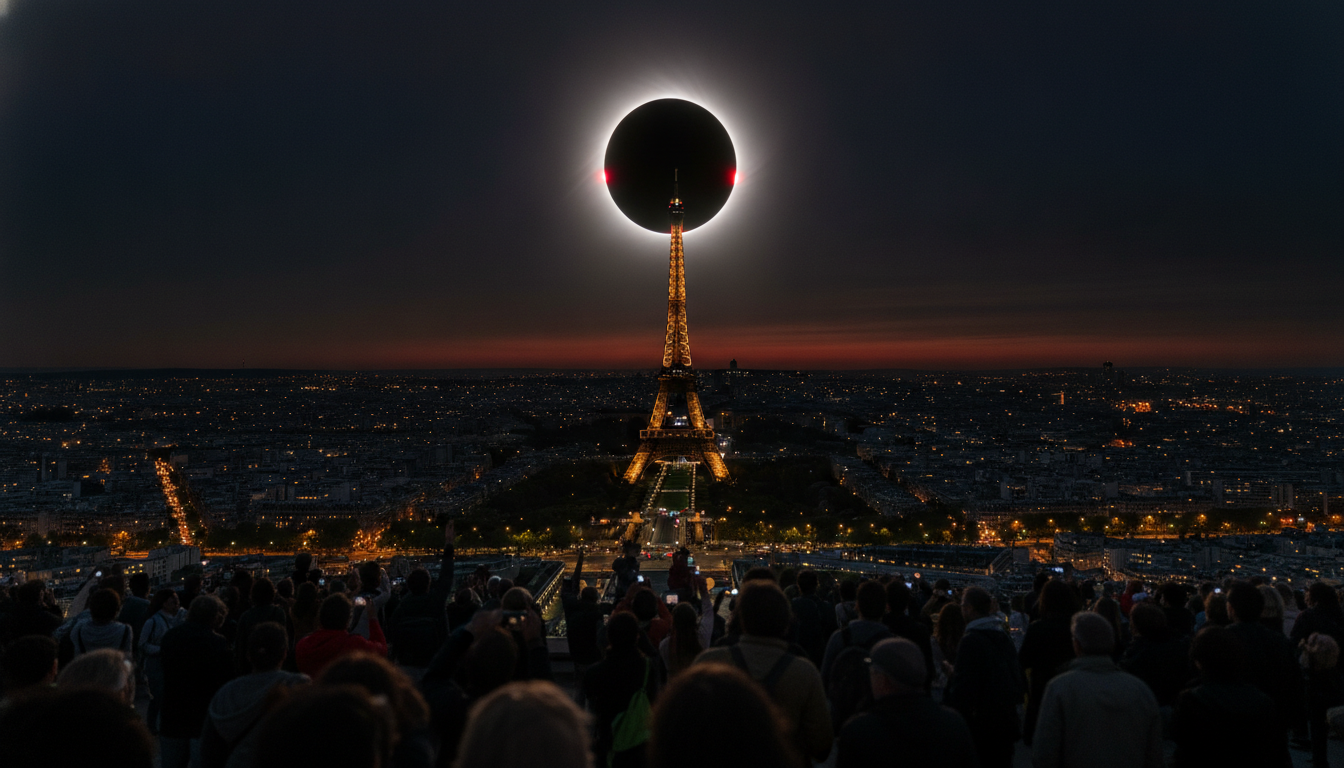
Total solar eclipse to darken parts of Europe on August 12, 2026
Millions across Europe will witness a total solar eclipse on Wednesday, August 12, 2026, with partial views available across Canada and other regions.
The Moon will pass directly between Earth and the Sun on Wednesday, August 12, 2026, producing a total solar eclipse along a narrow path that crosses Greenland, Iceland and parts of Europe. The phenomenon begins as a partial event and, for communities in the path of totality, will briefly turn daylight to near-night as the Sun’s bright disc is fully obscured.
Path and timeline of the eclipse
The eclipse sequence will start at different times depending on location, as the Moon’s shadow tracks from the Arctic toward continental Europe. Observers should expect the earliest partial phases to begin around 15:34 GMT at the first locations under the shadow’s advance. The first appearances of totality begin later in the afternoon UTC, with the event reaching its maximum near the centre of the track at about 17:46 GMT.
Local peaks of totality are timed differently along the path, with Reykjavik experiencing near-maximum darkness around 17:48 GMT and totality reaching western Spain at roughly 18:27 GMT. The global total phase will finish by about 18:34 GMT and the final partial contacts are expected to conclude by 19:58 GMT at the last affected locations.
Countries and populations inside the path of totality
The narrow band of totality will cut across northern Russia, parts of Greenland and Iceland before sweeping into Spain and a small portion of Portugal. Roughly 15 million people live within that band and will be able to experience the full darkness of totality, weather permitting.
Wider partial views will be visible across much of Western Europe and parts of northwest Africa, as well as across most of Canada and sections of the northern United States. Overall, nearly one billion people — approximately one in eight worldwide — will be in a position to see at least some degree of solar coverage depending on local cloud cover.
How the total solar eclipse will appear in European cities
Most major European cities will witness a dramatic partial eclipse during evening hours as the Sun sets. Paris is forecast to see about 92 percent of the Sun obscured, London around 91 percent and Berlin close to 85 percent, making for striking dusk-time skies.
Cities located inside the narrow path will experience a brief total darkness in which the Sun’s corona becomes visible. Spanish cities such as León, Valladolid, Zaragoza, Teruel and Valencia lie within the path of totality and will have prime viewing opportunities. Madrid and Barcelona fall just outside the band but will still experience more than 99 percent solar coverage.
Visibility and expected coverage in Canada
Canadians will not be in the path of totality, but large parts of the country will see a partial eclipse. The northeastern city of St. John’s, Newfoundland, is expected to observe about 53 percent coverage of the Sun, while Montreal should see roughly 18 percent and Toronto about 8 percent. Observers in Atlantic Canada and Newfoundland will have the deepest partial views in the country, and clear skies will be decisive for how much of the event is visible.
Residents planning to view the eclipse should check local timing and weather forecasts for precise peak times in their communities and prepare for rapid changes in light conditions during the event.
What observers will experience during totality
During totality the Moon completely covers the Sun’s bright surface for those in the narrow track, briefly turning daytime into twilight and revealing the solar corona — the Sun’s outer atmosphere that is normally hidden by its glare. Totality at the eclipse’s maximum should last up to about two minutes and 18 seconds near the centre of the path, though durations will vary by location and may be shorter in places on the periphery.
Outside the band of totality, spectators will witness a partial eclipse in which the Sun appears as a crescent or a disc with a shaved edge. Even a high percentage of coverage does not make direct viewing safe unless the Sun is completely blocked.
Safety and photography guidance for viewers
Looking directly at the Sun without proper protection can cause serious, permanent eye damage. For most of the eclipse, certified eclipse glasses or handheld solar viewers that meet established safety standards are essential. Inspect eyewear for scratches or damage before use and supervise children closely while they observe the Sun.
Do not use ordinary sunglasses in place of proper solar filters, and never look through cameras, binoculars or telescopes without a specialised solar filter fitted to the front of the optics. Photographers should protect camera sensors with purpose-made solar filters; only during the brief period of totality is it safe to remove filters for unfiltered shots, and filters must be returned to place immediately as the Sun reappears.
Live streams and the next total solar eclipse
For those who cannot travel to the path of totality, major space agencies will provide live coverage. NASA is scheduled to livestream the eclipse beginning at 17:15 GMT, offering extended views and expert commentary for international audiences.
Astronomy calendars show the next total solar eclipse after this event will occur on August 2, 2027, crossing southern Spain, parts of North Africa, and continuing across sections of the Middle East including Saudi Arabia and Yemen. For Canadians and the global public, the 2026 and 2027 eclipses offer two consecutive years of remarkable skywatching opportunities.
Observers are urged to prioritise eye safety, verify local timing, and allow for travel and weather variability when planning to view the total solar eclipse on August 12, 2026.
