
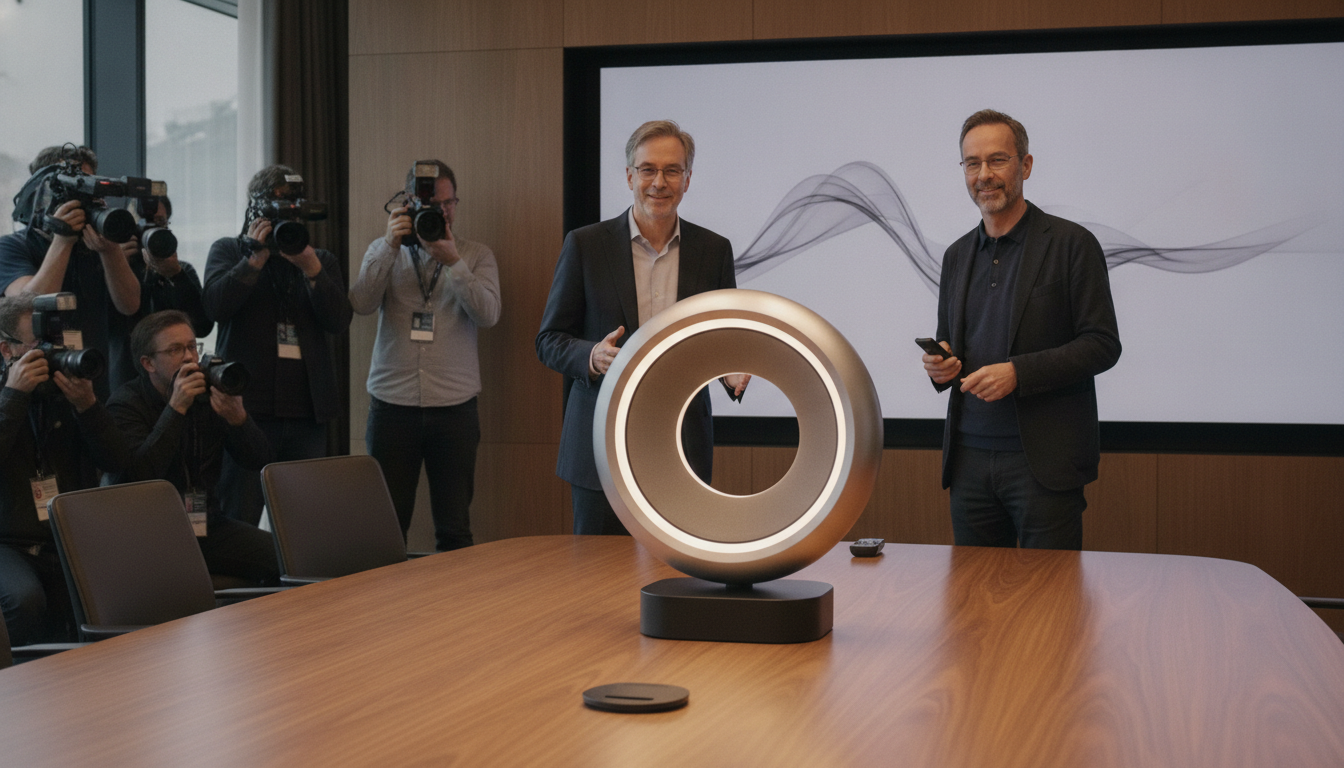
OpenAI smart speaker to be donut-shaped, metal and moveable, sources say
OpenAI smart speaker reported as a donut-shaped, metal, moveable device costing $300–$400, designed with LoveFrom and expected to ship in 2027 for home use.
OpenAI’s much-rumored hardware push has taken shape in new reports that describe a “donut”-shaped smart speaker designed to be carried around the home and to act as a physical companion for its conversational AI. The OpenAI smart speaker is said to feature a premium metal finish, visible moving parts, and a design emphasis on portability and placement across rooms. Sources close to the project describe a higher-end product with a projected price point in the $300–$400 range and an initial release window sometime in 2027.
Design described as doughnut-shaped and portable
The device’s most distinctive reported detail is its circular, hollow form factor, which company sources say is intended to make the unit easy to lift and reposition. The “donut” silhouette is positioned as a deliberate choice to enable users to move the speaker to a bedside table, kitchen counter, or living-room shelf without awkward handling. Reporters who have spoken with people familiar with the project say the form is both an aesthetic and functional decision aimed at making the product feel less like fixed infrastructure and more like a personal gadget.
The description emphasizes physically interactive qualities that separate it from today’s cylindrical or puck-style speakers. Its surface is described as metal with a “premium” finish, and the device reportedly incorporates moving parts whose purpose has not been fully explained by sources. That mechanical element has prompted questions in industry circles about durability, complexity and the types of interactions OpenAI intends to enable.
Mobility and in-home use cases highlighted
Company allies have framed the unit as a companion extension of the ChatGPT experience, designed to bring conversational AI into everyday household contexts. Supporters envision the speaker following users between rooms to provide reminders, answer queries, manage smart-home devices, and offer a persistent conversational presence where a phone or laptop might not be convenient. The portability narrative positions the product against stationary smart speakers by selling the idea of an AI that can be physically relocated to match the user’s routine.
Practical use cases remain illustrative rather than confirmed, and analysts note that software and integration will determine whether the portability feature becomes a meaningful advantage. Battery life, network handoffs, and privacy controls will be central to whether consumers adopt a moveable AI speaker as a core part of their homes.
Projected price puts product in a premium bracket
Reports place the OpenAI smart speaker’s retail price in the $300–$400 range, a level significantly above many mainstream voice-enabled speakers. For context, popular smart-home speakers from dominant retailers often sit between roughly $40 at the low end and around $240 for premium models. The higher price could reflect materials, design partnership costs, and the inclusion of novel hardware elements, but it also raises questions about market fit and return on investment for consumers.
Industry watchers caution that smart speakers have historically been challenging profitability propositions for some manufacturers, who subsidize hardware to sell services. Breaking into a market dominated by established ecosystems will require either a compelling hardware advantage, unique services tied to the speaker, or a strategy for sustaining software revenues.
LoveFrom collaboration and release timeline reported
The device is reported to be designed in partnership with LoveFrom, the design studio led by Jony Ive, whose work at Apple established a reputation for product aesthetics. That collaboration signals OpenAI’s intention to position the speaker as a design-forward consumer product rather than a purely utility appliance. Sources indicate the company is aiming for an initial launch sometime in 2027, though a specific month or retail strategy has not been disclosed.
A design partnership of this profile also suggests attention to fit-and-finish and retail presentation, and it could explain a premium price. Observers expect the public reveal to include demonstrations of the device’s mobility and interactive capabilities, with follow-on announcements detailing software features and subscription models.
Legal dispute with Apple introduces uncertainty
OpenAI’s hardware ambitions face a complicating factor in an ongoing legal dispute with Apple, which has accused OpenAI of misappropriating trade secrets related to device development. OpenAI has denied the allegations, but the lawsuit introduces potential legal and logistical uncertainty that could affect timelines and partnerships. The case adds another variable to a product rollout that already needs to navigate design, engineering, supply-chain and market-demand hurdles.
Legal proceedings may delay development milestones or alter the public narrative around the product, depending on how they unfold and whether any injunctions or settlement terms touch the device program. Observers say the dispute will be watched closely by investors and partners as it could influence confidence in OpenAI’s hardware roadmap.
Consumer and market reaction will be shaped not only by the finished product but by details that remain unconfirmed, including battery life, audio fidelity, software capabilities and privacy safeguards. As OpenAI prepares what appears to be a deliberate move into consumer hardware, the company faces the twin challenges of convincing buyers that a higher-priced smart speaker is worth owning and ensuring the device integrates smoothly with home technology ecosystems.
Ahead of any official announcement, prospective buyers, partners and regulators will be watching disclosures about features, pricing and legal outcomes, all of which will determine whether the OpenAI smart speaker becomes a sought-after premium accessory or a risky first step into hardware.
