
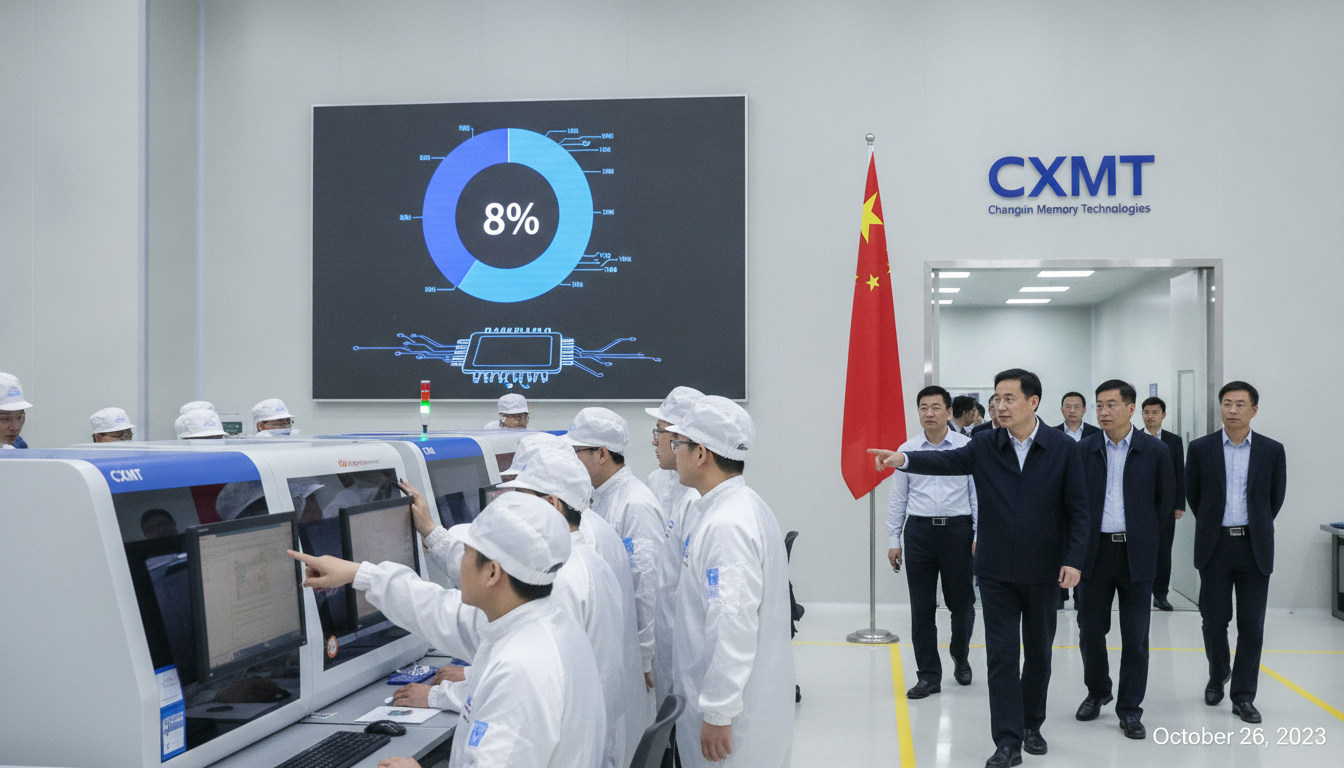
CXMT Emerges as China’s Fourth-Largest DRAM Manufacturer, Holds Nearly 8% Global Share
CXMT rises as China’s fourth-largest DRAM maker with ~8% market share, backed by Beijing to boost memory self-sufficiency versus Samsung, SK Hynix, and Micron
Opening summary
China’s CXMT has established itself as the world’s fourth-largest producer of DRAM memory chips, commanding roughly 8 percent of the global market. CXMT’s rise comes as Beijing increases financial and strategic backing to reduce reliance on established suppliers. The expansion has sharpened focus on competition with Samsung, SK Hynix and Micron, which together still account for the overwhelming majority of DRAM shipments.
CXMT’s market position and scale
CXMT’s near 8 percent share places it behind the long-time leaders yet ahead of many smaller regional suppliers. The company supplies memory used across smartphones, servers and consumer electronics, positioning it in the core of the semiconductor value chain. Its growth reflects a targeted push to move China from a components importer to a more self-reliant chip producer.
CXMT’s output remains modest compared with the top three suppliers, which together account for roughly 90 percent of global DRAM capacity. That concentration means CXMT’s gains will change market dynamics slowly rather than immediately overturn established pricing or supply patterns. Nevertheless, its presence introduces an alternative source for buyers and could influence sourcing decisions over the coming years.
State backing and strategic objectives
Chinese government planning has identified DRAM as a strategic industry for technological independence, and CXMT is a clear beneficiary of those priorities. Support has included direct investment, favorable loan terms and other industrial policy tools aimed at accelerating domestic capacity and research. For policymakers, developing a competitive domestic memory industry reduces exposure to foreign supply shocks and export restrictions.
This state support also gives CXMT resources to scale faster than a private company might on its own, but it comes with expectations for rapid improvement in yield rates, product variety and manufacturing sophistication. The company is under pressure to translate funding into sustained technical progress and competitive products that can meet global performance and quality standards.
Competition with Samsung, SK Hynix and Micron
The DRAM market remains dominated by three companies: Samsung and SK Hynix of South Korea and Micron of the United States. These firms lead in advanced process technology, cost-efficiency and large-scale production facilities. Their dominance has created high barriers to entry for challengers aiming to supply cutting-edge DRAM used in hyperscale data centers and premium mobile devices.
CXMT’s strategy appears oriented toward capturing segments where scale and proven technology are less decisive, such as mid-tier mobile memory and regional enterprise demand. Even so, closing the technology gap will require sustained investment in R&D and access to sophisticated manufacturing equipment, an area where incumbents currently hold advantages born of decades of engineering refinement.
Technical and supply-chain challenges
Manufacturing DRAM at scale involves complex lithography, process control and yield optimization that take years to master. New entrants must tackle high defect rates, equipment sourcing restraints and the steep learning curve associated with process nodes. These technical hurdles can slow production ramp-up and increase costs until efficiencies are achieved.
Access to key tools and materials adds another layer of difficulty, particularly for companies operating within sensitive geopolitical trade environments. Supply chains for advanced semiconductor equipment are tightly interwoven with companies and jurisdictions that are cautious about technology transfer, complicating efforts to import the latest manufacturing systems and components.
Market impact and pricing dynamics
CXMT’s growing supply could introduce incremental price competition in certain DRAM segments, particularly in regional markets and commodity-grade products. Buyers seeking diversification may welcome additional suppliers that can offer competitive pricing or alternative contractual terms. Over time, increased competition can exert downward pressure on margins across the industry, though the most advanced DRAM tiers are less susceptible to rapid price shifts.
For incumbent suppliers, a new mid-sized competitor alters procurement calculus rather than displacing market leaders overnight. The biggest suppliers will likely respond with continued investment in process leadership, customer relationships and capacity management to safeguard their high-end market positions.
Industry outlook and investor considerations
Analysts monitoring memory markets view CXMT’s ascent as an important structural development rather than an immediate threat to the top tier. A gradual improvement in CXMT’s technical capabilities could over several years translate into steadier market share gains, especially if government support remains consistent. Investors and customers alike will watch yield improvements, product portfolios and contractual wins as indicators of the company’s trajectory.
Longer term, the evolution of CXMT and other domestic Chinese memory efforts will factor into broader supply-chain strategies for global electronics makers. Companies that diversify suppliers and hedge against geopolitical risk may find room to incorporate emerging producers, while those focused on top-end performance will continue to rely on established suppliers.
China’s push to build competitive domestic DRAM capacity through firms such as CXMT is reshaping the contours of the global memory market, but the road to parity with the industry’s leaders will likely be measured in years and require sustained technical progress and international supply-chain access.
