
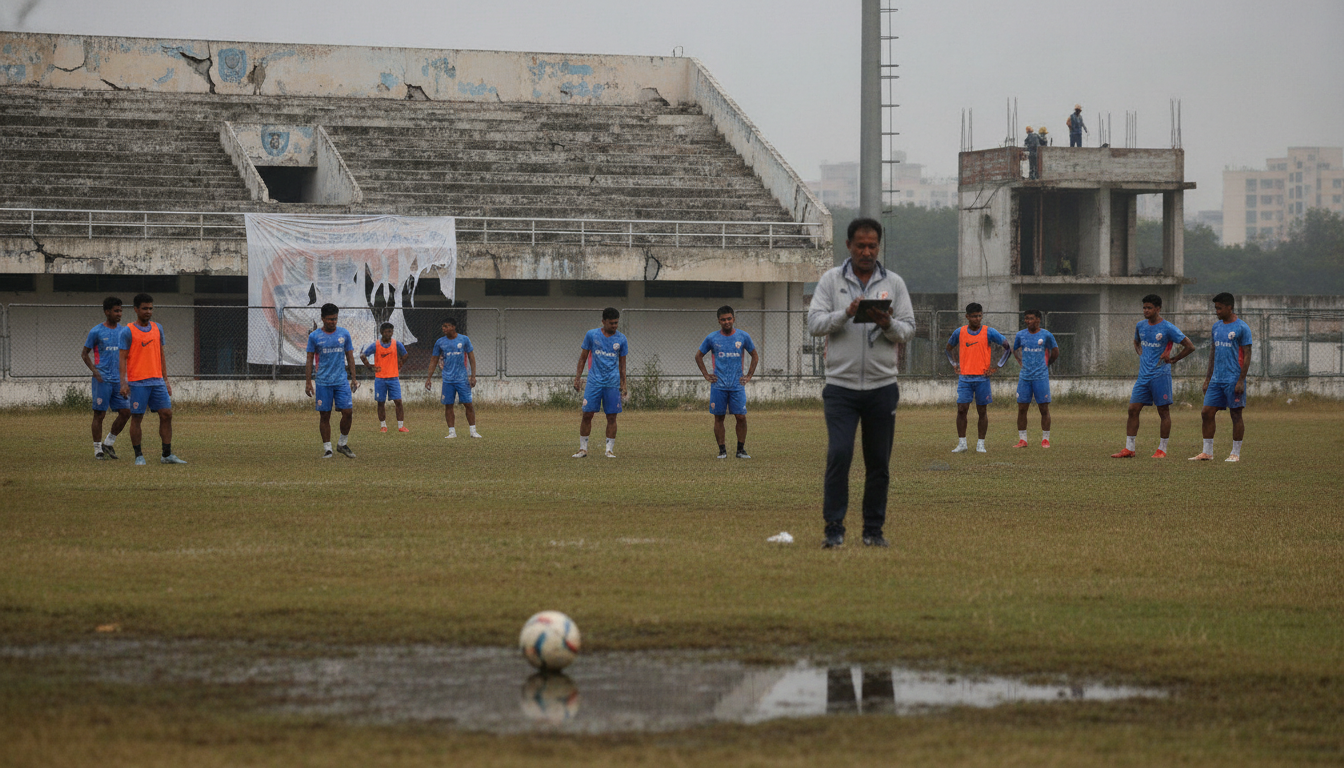
Indian football’s long road back as systemic failures keep national team ranked 138th
Indian football left 138th and missing major tournaments; experts blame weak youth development, fractured governance and funding gaps. Fans remain hopeful
Indian football finds itself at a crossroads after another major qualification cycle ended in disappointment, leaving the national team ranked 138th and outside key regional competitions. A growing chorus of coaches, club executives and state officials say entrenched governance problems, uneven youth development and financial instability are the chief obstacles. The gap between supporters’ hopes and the reality on the pitch was highlighted by one fan’s transcontinental pilgrimage to the 2026 World Cup, underscoring how passion for the sport has outpaced results.
Fan pilgrimage highlights emotional stakes
Gourav Roy, an Indian software engineer based in San Francisco, drove more than 9,650 kilometres across the United States to attend the World Cup semifinals and final, a journey that reflected longstanding pride in the game. His trip has become emblematic of a fan base that remains deeply committed even as the national team struggles to compete at the highest level. That commitment keeps public attention on the failure to translate enthusiasm into international success.
Supporters say the emotional investment amplifies frustration when governance and development issues prevent progress. The contrast between high-profile global stars visiting India and the national team’s underperformance has fueled a sense of wasted potential. Many fans cling to the idea that structural reforms could unlock growth if implemented coherently.
Federation reform remains stalled
At the centre of the crisis is the All India Football Federation, which critics say has been slow to implement a uniform, nationwide strategy. Legal disputes over a new constitution and stalled partnerships with major corporate backers have exacerbated uncertainty. Several insiders stress that without a stable governance framework, long-term planning and investment will remain limited.
Club executives argue that the federation must act as a convenor to bring state associations, private investors and government bodies into a coordinated plan. Observers note that piecemeal decisions by isolated entities cannot substitute for a nationally consistent approach to leagues, youth pathways and coaching standards. Reform advocates warn that delay will cost India critical development years.
Support concentrated in a few states
Football’s popularity in India is still largely confined to pockets such as West Bengal, Goa, Kerala, Mizoram and Manipur, where local cultures have sustained the game. Outside these regions, cricket dominates public life and sponsorship, making it hard for clubs to expand their fan bases. The regional nature of support complicates efforts to build a nationwide system of youth leagues and scouting networks.
State associations that do invest in grassroots structures point to tangible benefits, but those efforts are uneven in scale and execution. Because India is vast, scaling successful local models requires federation and government coordination, along with long-term funding commitments. Experts say that if half the states adopted robust grassroots programmes, momentum could shift significantly in a decade.
Youth fixtures and coaching shortfalls
Technical leaders cite a chronic shortage of competitive fixtures for young players and a deficit of qualified coaches as central failings. In rival Asian nations, youth players may play 40 or more competitive matches a season; in many parts of India under-15s get fewer than 20. That lack of match experience, coupled with late identification and training, leaves promising players unprepared for elite international competition.
Coaching certification and player pathways are often inconsistent, especially outside the handful of footballing states. Analysts emphasize that increasing the number of meaningful youth matches and investing in coach education are foundational steps. Without these fixes, talent identification and progression will remain haphazard.
ISL instability undermines club development
The Indian Super League was launched in 2014 with significant corporate backing to professionalize the sport, but recent turbulence has undermined its promise. Negotiations to renew major partnerships have stalled and, in 2025, some teams faced salary suspensions as financial models were reworked. Club executives warn that instability at the top league level directly damages youth academies and long-term planning.
League organisers and clubs now face pressure to finalize broadcasters, fixtures and governance arrangements to restore investor confidence. Several club leaders say sustained league stability is a precondition for attracting corporate partners and improving player development. Observers note that without predictable revenue streams, academies and grassroots programmes struggle to survive.
Policy proposals and a narrowing window
As India prepares a broader national push for sporting excellence with a 2036 Olympic bid under consideration, policymakers have discussed measures such as a “sports passport” to allow athletes of Indian origin to represent the country. Federation leaders have voiced support for initiatives that could quickly strengthen national squads, but legal and logistical hurdles remain. Officials stress that such measures are not a substitute for systemic reforms, which require years of consistent work.
Several federation insiders estimate that overhauling the system could take a four-year cycle to show structural improvement and decades to reach World Cup quality. They warn that other Asian nations are accelerating their own programmes, meaning India’s window for catching up may narrow without immediate action. The imperative, they say, is to combine governance fixes, targeted funding and local capacity-building.
Despite institutional challenges, many fans and stakeholders hold out hope that incremental change can alter the trajectory. Supporters like Roy continue to follow global tournaments and hope expanded competitions will create more opportunities for emerging nations. That longing for progress puts added pressure on administrators to convert ambition into measurable reform.
The next phase for Indian football will hinge on whether policymakers, corporate backers and state associations can move past short-term disputes and invest in a coordinated, grassroots-led model that prioritizes coaches, competitions and consistent governance. Only a unified effort that links local development with national strategy can offer a realistic path back to competitiveness on the continental and world stage.
