
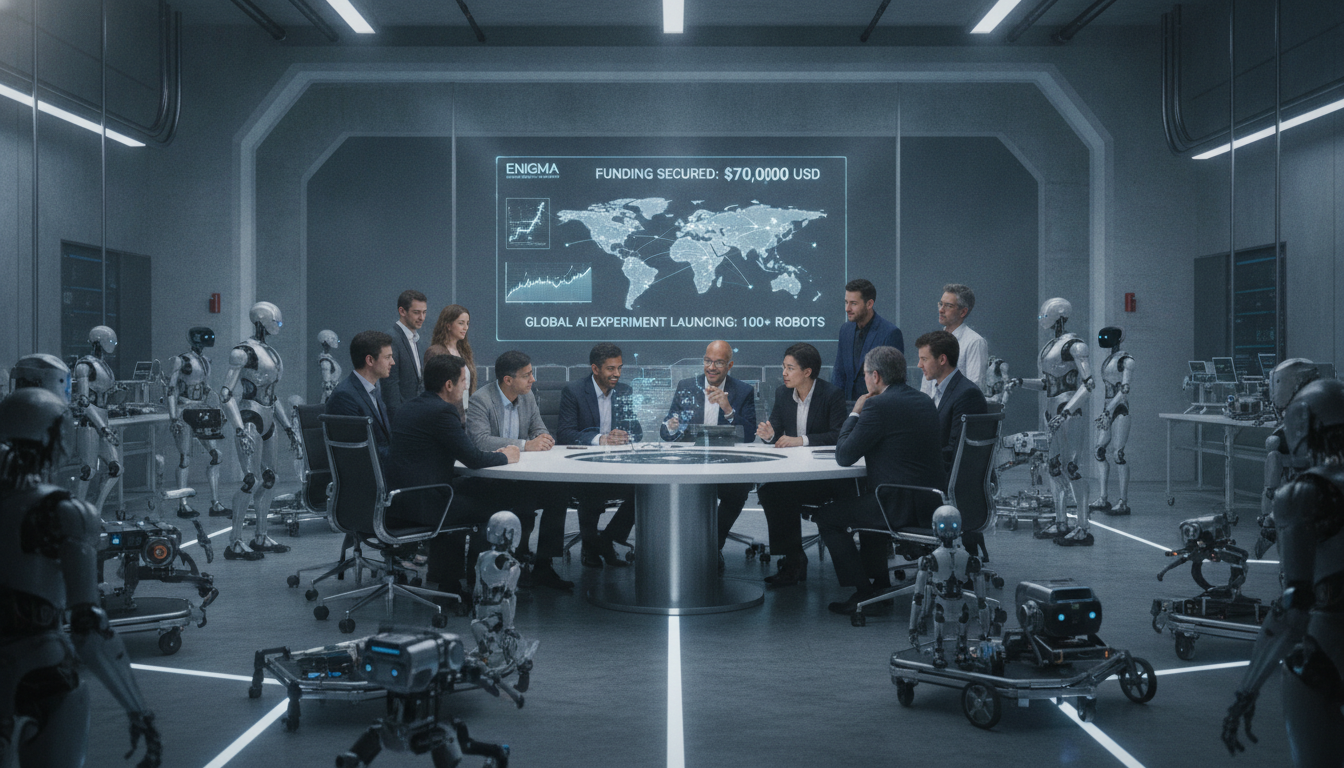
Enigma raises $70M to study human-robot interaction with public experiment of 100 AI robots
Enigma raised $70M to study human-robot interaction, opening a public test with 100 AI robots to find intuitive interfaces and train foundation models
Enigma, a recent startup focused on human-robot interaction, announced a $70 million seed round and launched a large-scale public experiment that invites people worldwide to engage with more than 100 of its proprietary AI-driven robots. The experiment, hosted in hangars in Israel and California, is designed to collect real user data on how people naturally communicate tasks to robots. The company says the feedback will inform both interface design and the development of new foundation models for embodied intelligence.
Funding and public test details
Enigma secured $70 million in seed financing led by Index Ventures and Ribbit Capital, with participation from several prominent investors including Sarah Guo of Conviction Partners. The capital will support the construction of hardware, expansion of facilities, and the rollout of the public online experiment. By inviting a broad set of users to control robots remotely, Enigma aims to amass a dataset that spans language, gestures, demonstrations, and other interaction modes.
The public experiment features robots that perform a range of tasks, from fine-motor activities like painting to more dynamic scenarios such as staged sword fights and basic chemistry tasks involving handling flasks. The company asserts that it built both the robotic arms and the underlying AI stacks internally, and that the test will evaluate which communication modalities people prefer and find most effective. Enigma’s approach is explicitly empirical: it plans to change interfaces, collect responses, and iterate based on observed behavior.
Founders’ background and team composition
Enigma was co-founded by Jonathan Jacobi and Gal Niv, two entrepreneurs who first connected in youth hacking competitions and later served together in Israel’s Unit 8200. Jacobi, who has been noted for early-career roles at major technology companies, and Niv brought together a team drawn from Israel’s tight-knit tech and research communities. The startup recruited staff including alumni of top AI labs, math Olympiad winners, and several researchers who left academia to join the effort.
The founders describe themselves as outsiders to traditional robotics, an intentional stance they say allows for unconventional thinking. Investors cited that outsider status as a reason the company can reframe problems around user experience rather than starting from established teleoperation or dexterity assumptions. That framing underpins both their hiring choices and the experimental design of the public test.
Experiment design and robot capabilities
The robots in Enigma’s hangars are arranged to support a variety of interactions, with cameras and sensors streaming live to remote users. Tasks presented to participants range in complexity and modality, enabling the company to observe how people choose to communicate—whether by text, voice, video examples, or direct manipulation interfaces such as tap-and-drag gestures. Enigma plans to compare those signals against task outcomes to determine which inputs most reliably produce desired behavior.
According to company statements, the robots can perform coordinated grasping, fine manipulation with paintbrushes, and basic laboratory-style handling of flasks and liquids. The physical setups are intended to be diverse enough to elicit different user strategies, which the startup hopes will reveal latent preferences for interaction styles. Data from these sessions will feed both supervised training and research into new foundation models optimized for embodied tasks.
Research strategy: interaction-first foundation models
Enigma’s stated research thesis is that building foundation models for robots should start with how humans want to interact with machines, not only with raw scale or simulated data. Rather than solely mining web videos or running vast physics simulations, the company emphasizes real-world human-robot engagement as the primary signal. The goal is to learn interfaces and model structures that generalize to tasks robots were not explicitly trained to perform.
That interaction-first approach aims to produce models that translate heterogeneous human signals—spoken instructions, demonstrations, or simple gestures—into robust robotic actions. Enigma argues this could close a gap where capable models still fail in practical home or workplace contexts because the effort to teach a robot remains too high. The startup’s experiment is thus both a user interface study and a data collection effort for model research.
Commercial partnerships and possible applications
While Enigma has not disclosed a single flagship commercial product, the company reports early partnerships in sectors such as healthcare, logistics, and entertainment. Investors and founders describe the current phase as exploratory: the public data will help identify where intuitive human-robot interfaces unlock clear business value. Potential near-term applications range from assisted tasks in care environments to automated packing and creative entertainment demonstrations.
The company’s openness about early partnerships suggests a dual-track strategy: refine core models and interfaces with public input while piloting domain-specific deployments with commercial partners. That path could allow Enigma to both monetize specialized solutions and retain rights to a broader interaction-centric foundation model applicable across industries.
Context within the robotics and AI ecosystem
Enigma enters a crowded field where companies are pursuing foundation models for robotics through varied means—large video datasets, simulation, and sensor-equipped human motion capture among them. What differentiates Enigma is its attempt to foreground human interaction as the primary research lever. Investors have framed that distinction as a potential competitive advantage, especially if the experiment uncovers simple, repeatable interfaces akin to the “car volume knob” analogy the founders use.
Industry observers caution that translating public experiment results into generalizable models is nontrivial, and that safety, reliability, and data quality will be key challenges. Enigma’s experimental approach will be judged on whether it can produce reproducible gains in usability and model robustness beyond lab conditions.
The startup’s public experiment and the $70 million backing mark a notable bet on the idea that the next leap in embodied AI will come from studying people, not just machines. If the data reveal consistent interaction patterns, Enigma could influence how robots are designed, taught, and integrated into daily life.
Enigma’s experiment aims to reveal which methods people naturally choose to communicate tasks to robots and whether those choices can train models that generalize to new activities. The company plans to use the findings to refine interfaces and train foundation models that make robotic assistance more intuitive and less effortful for everyday users.
