
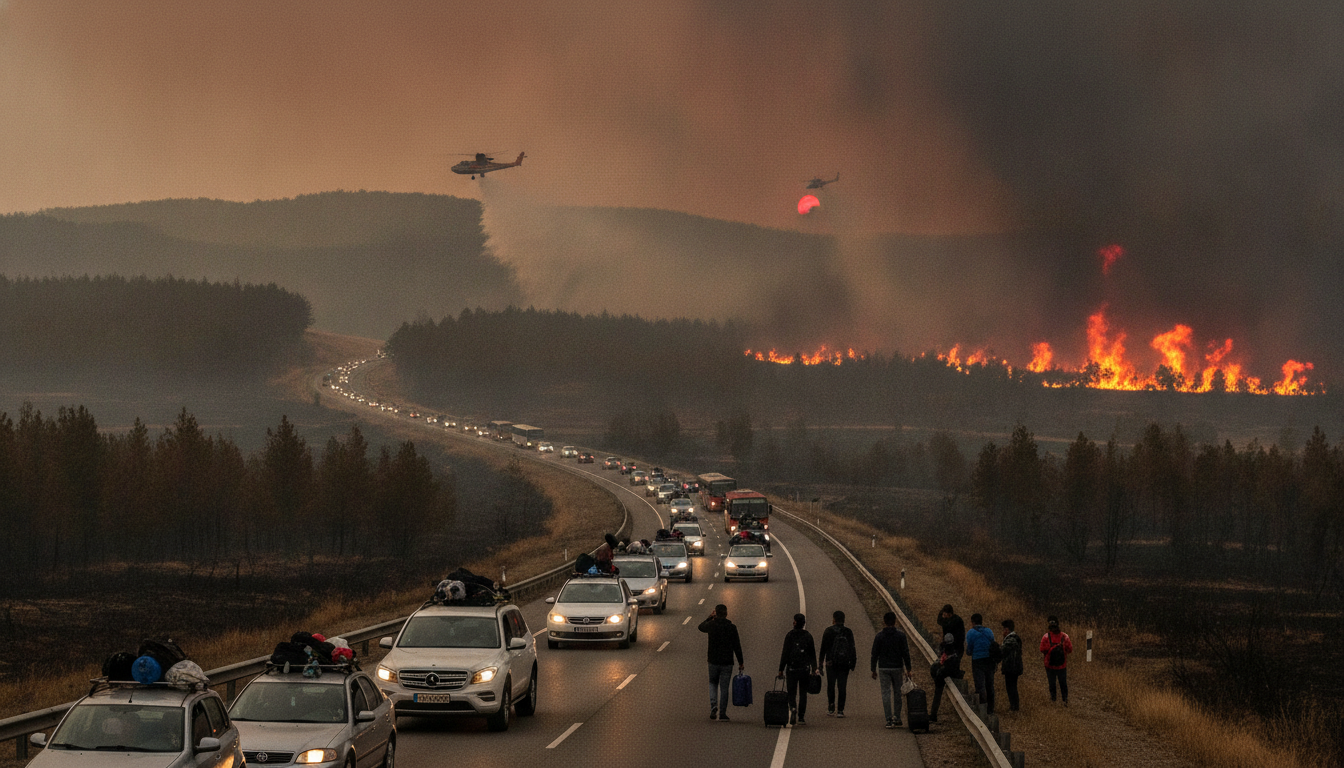
France and Spain wildfires force mass evacuations as flames threaten Bordeaux and central Spain
France and Spain wildfires prompt mass evacuations and scorch vast areas, as authorities and EU partners deploy firefighters and aircraft amid extreme heat.
The France and Spain wildfires that have raced across southwestern Europe this month have forced the evacuation of more than 325,000 people and consumed hundreds of thousands of hectares of forest, farmland and scrub. Authorities in both countries describe an unprecedented emergency driven by fast-moving flames, extreme weather and rare fire-driven storm clouds that have made suppression efforts perilous. Firefighters and international partners have been mobilized as cities and tourist regions brace for further spread.
Evacuations and scale of destruction
Across both countries officials have moved large swathes of the population away from advancing fires to protect life and property. French authorities report roughly 220,000 people evacuated from areas around Bordeaux and the Atlantic coast, while Spain has relocated about 75,000 residents and advised another 30,000 to shelter in place. Combined totals exceed 325,000 people, with large numbers still living in temporary accommodation or under evacuation orders.
The area burned this year is already striking: France’s interior minister has said about 115,000 hectares have been lost to wildfires since January. Copernicus’s European Forest Fire Information System recorded roughly 119,458 hectares burned in Spain as of July 22, while Spain’s prime minister has cited a national toll exceeding 150,000 hectares since January. The United Nations reported that Europe saw 2.2 million hectares burned in 2025, highlighting a trend of growing wildfire impact.
Fire behaviour and pyrocumulonimbus hazards
Fire scientists and meteorologists warn the situation is amplified by pyrocumulonimbus clouds — intense, fire-generated thunderclouds that can produce dangerous winds, embers and even lightning. Those clouds create powerful updrafts that loft burning material, spreading spot fires kilometres from the main blaze and complicating aerial and ground firefighting. Officials say the phenomenon, common in regions like Canada and Australia, has become a decisive and hazardous feature of this season’s fires in southwest Europe.
French firefighters described conditions approaching “operational impossibility” as lightning and embers ignited new blazes under low visibility and erratic winds. The combination of extreme heat, dry vegetation and these storm-like fire clouds has shifted many operations from offensive suppression to defensive protection of communities, officials said.
Threat to Bordeaux, Cap Ferret and tourist areas
The blazes have reached the outskirts of major population and tourist centres, prompting emergency measures to shield infrastructure and popular destinations. Fires on the Cap Ferret peninsula and surrounding areas near Arcachon sent smoke over seaside towns and forced cancellations of train services. Local officials moved nearly 197,000 people from zones around Bordeaux to reduce risk as flames approached within tens of kilometres of the metropolitan area.
Officials stressed there were no immediate plans to evacuate central Bordeaux itself, but warned residents to expect travel disruptions and air quality impacts. The wildfires also forced a late change to national events, with the final stage of the Tour de France shortened after security personnel were redeployed to firefighting duties.
Government action and international support
Both Madrid and Paris have convened emergency meetings and raised the national response level as ministers and leaders toured affected provinces. Spanish Prime Minister Pedro Sánchez visited fire-hit areas in central Spain and said his government would declare a civil protection emergency to unlock additional resources and recovery funding. France’s prime minister and president held crisis talks while ministries coordinated evacuations and relief.
The European Union’s civil protection mechanism has been activated, with several member states sending aircraft and equipment to assist. Greece and Italy deployed firefighting planes to Spain; Portugal sent more than 100 military personnel and support gear; and Turkey pledged additional aircraft. Spain and France have appealed for further international help as some blazes remain classed as “out of control.”
Underlying drivers and land-use challenges
Experts say the fires are the product of multiple, interacting factors beyond immediate weather conditions. Climate-driven temperature rises, prolonged heatwaves and drier soils are increasing the frequency and intensity of fire-prone conditions across Europe. Copernicus data shows Europe warming faster than the global average, a trend officials say is heightening wildfire risk and season length.
Land-use patterns, ageing or poorly planned urban fringes and agricultural practices also complicate response. Specialists noted that areas developed without robust infrastructure or water access, and those where wildlands and built-up zones meet, create complex and hazardous firefighting environments. Agricultural fires and dry crops can trigger rapid spread that overwhelms local resources.
The combination of inadequate planning and an accelerating climate signal has prompted warnings that current emergency preparations and worst‑case scenarios are being overtaken by events. Analysts say governments need to update risk models, land management, evacuation planning and resources to match faster changes in wildfire behaviour.
Last week’s blazes underlined that communities and emergency services are confronting a new normal in which extreme heat and convective fire storms can subvert traditional firefighting tactics. As firefighters battle active fronts, authorities cautioned that containment will depend on changes in weather and sustained international assistance.
While immediate priorities remain evacuations, rescues and protecting critical infrastructure, officials and experts urged policymakers to take a longer view on forest management, urban planning at the wildland‑urban interface and investment in resilient firefighting capacity. The scale and ferocity of the France and Spain wildfires this season leave communities bracing for more frequent episodes unless adaptation and mitigation measures are accelerated.
