
Encord tests brain-wave tagging to manufacture scarce robot training data in San Leandro
Encord creates brain-wave and muscle-sensor annotated datasets in a San Leandro lab to manufacture scarce robot training data for warehouse and humanoid robots.
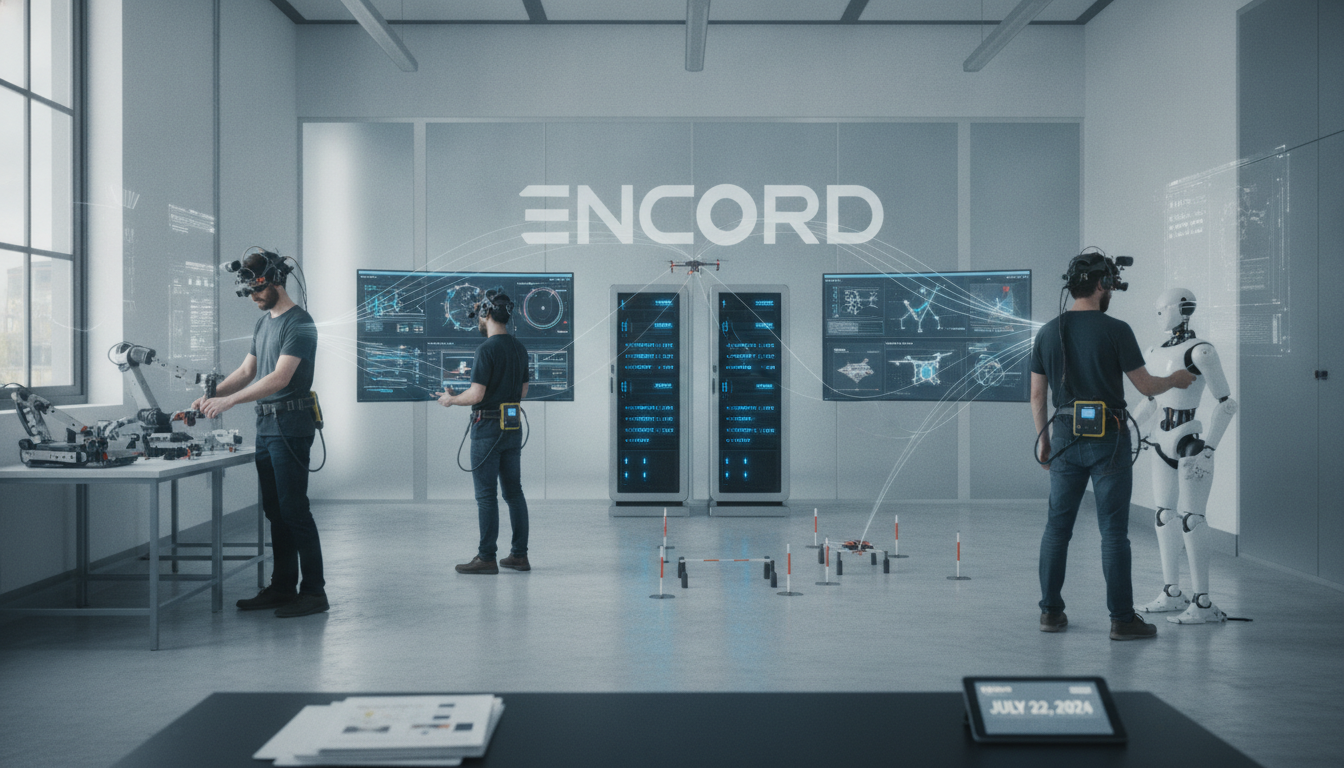
Encord has turned a San Leandro warehouse into a testbed for a new approach to robot training data, combining egocentric video, muscle sensors and brain-wave tagging to produce higher-fidelity examples for manipulation tasks. The company says the effort aims to address a critical shortage of real-world physical data needed to train warehouse and humanoid robots. Early trials pair human operators with leader-follower rigs while recording video, physiological signals and detailed annotations to create datasets designed for end-to-end robot learning.
San Leandro lab experiments with brain-wave tagging
Zander Labs headsets measuring brain activity are in trial use at Encord’s facility, where operators wear the devices while performing manipulation tasks. Encord’s engineers hope signals tied to surprise, intent or error will highlight moments when models should deploy greater compute or attention. The company plans to run the brain-tagged recordings through customer models to evaluate whether the new labels measurably improve performance before deciding whether to scale the approach.
Egocentric footage and leader-follower rigs
A core part of Encord’s data strategy is egocentric video captured by workers wearing head-mounted cameras, augmented by multiple camera angles to increase scene fidelity. Operators also use leader-follower rigs—paired robotic arms that mirror human motion—to generate precise demonstrations of pouring, grasping and cable manipulation. Those demonstrations create the sorts of manipulation examples that general-purpose video collections typically lack.
Muscle sensors and richer motion capture
To compensate for the blind spots of standard video, Encord is adding electromyography-style sensors to forearms to record muscle signals that infer hand and finger motion. That modality creates a more complete three-dimensional depiction of how a human reaches, rotates and adjusts grip in real time. Combined with video and annotation, the sensor package is intended to yield labels that help models learn subtler aspects of dexterity.
Dense annotation to accelerate model understanding
Encord annotates each recording with fine-grained, action-level descriptions—phrases such as “right hand tightens bolt” rather than generic tags—to make footage intelligible to language-guided models. The company argues dense, structured annotation multiplies the value of each sample for targeted manipulation tasks. Although richer labels are more expensive than raw ego video, Encord estimates the cost-performance tradeoff favors denser datasets for fine-tuning production-grade robot behaviors.
Economics of manufactured data versus scraped corpora
The effort underscores a shift in robotics: unlike language models that grew by scraping massive public text, physical-AI training examples must be manufactured and curated at cost. Encord’s leaders stress that producing realistic manipulation data requires human labor, instrumentation and controlled scenarios, all of which change the unit economics of model development. That difference helps explain why a market has emerged for companies that both create and manage physical training data rather than merely labeling what customers already collect.
Encord’s industry position and cross-customer visibility
Encord says working across multiple robotics teams gives it a vantage point to spot effective data modalities and labeling practices before single labs scale them internally. The company’s customer base includes a range of warehouse automation and humanoid projects, according to executives, and the San Leandro facility serves as an experimentation ground for commonly requested skills. That middle-market role—both custodian and manufacturer of robot training data—forms the core of Encord’s commercial pitch.
Pilots at the facility perform a variety of scripted and semi-structured tasks using props that mimic real warehouses and homes, from plugging ethernet cables to pouring liquids and stacking items. Those tasks are chosen because they expose subtleties in manipulation that simple video cannot capture, such as the wrist torque needed for certain plugs or the micro-adjustments when balancing uneven loads. The human operators who run these sessions come from annotation and robotics backgrounds and now act as a growing workforce whose work directly produces the training examples that will teach future robot hands.
Encord’s trials with brain-wave and muscle-sensor modalities reflect a broader industry recognition that physical interaction data is scarce, expensive and indispensable. If the company can show consistent gains from the new labels, it will provide a replicable model for how to manufacture robot training data at scale. For now, Encord’s San Leandro lab is a concentrated attempt to bridge the gap between the data-rich world of text and the sparse, tactile needs of embodied machine learning.
