
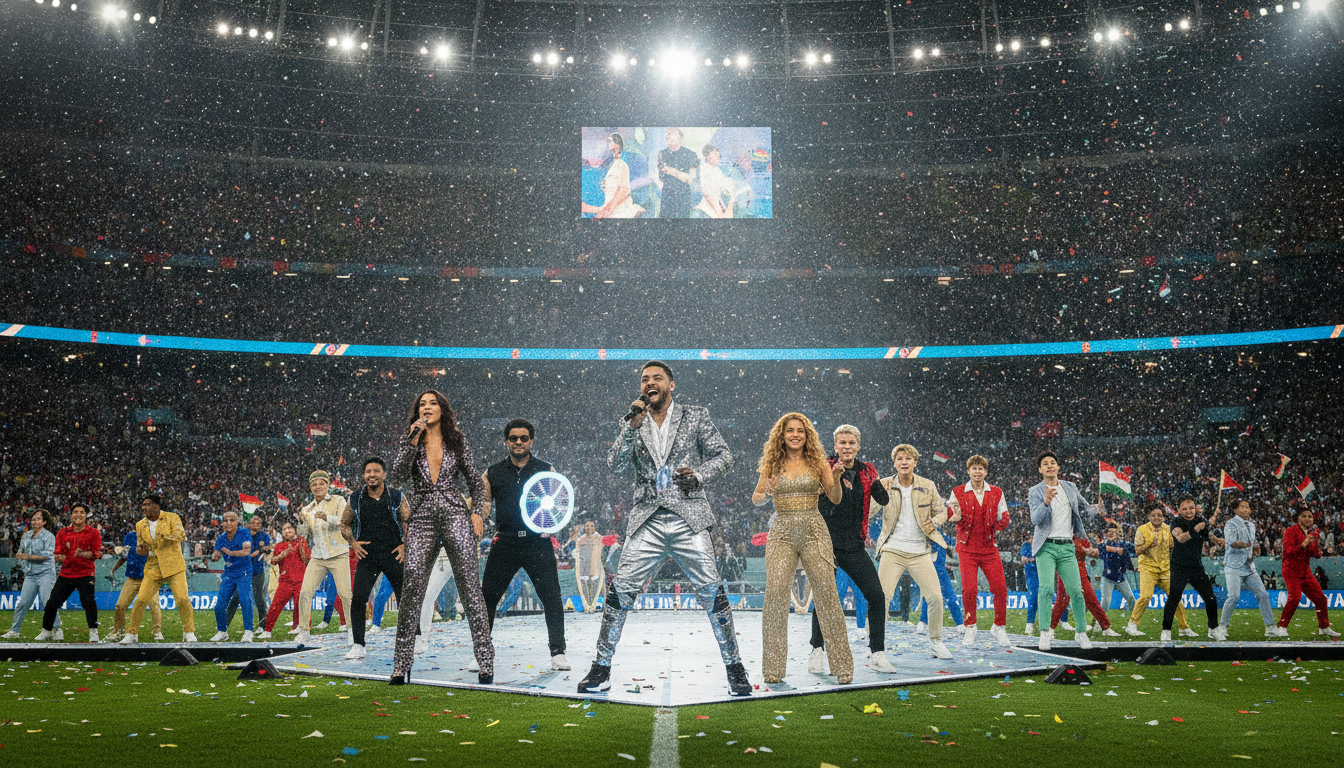
Emmanuel Kelly to perform in FIFA World Cup 2026 final halftime show
Emmanuel Kelly will perform in the FIFA World Cup 2026 final halftime show alongside Shakira, BTS, Justin Bieber and Madonna, marking a rare international platform for the Iraqi-Australian singer.
Emmanuel Kelly, an Iraqi-born singer who was abandoned as a baby and later adopted by an Australian humanitarian, is confirmed among the headline performers for the FIFA World Cup 2026 final halftime show. The announcement places Kelly on a stage curated by Coldplay frontman Chris Martin and lifts a spotlight on his personal journey from an orphanage in Baghdad to global stadiums. Organisers have highlighted Kelly’s role as a milestone in representation for artists with disabilities at major sporting events.
Emmanuel Kelly added to World Cup half‑time lineup
Kelly will appear in the halftime production assembled for the final at the MetLife Stadium, joining a roster of international stars that FIFA expects to reach a global television audience. The performance follows a series of high-profile collaborations for Kelly, and FIFA has described the lineup as one of the most widely watched musical moments in the tournament’s history. Event organisers and the show’s curator have emphasized diversity and global unity as central themes of the programme.
Rescue and medical care in Baghdad and Australia
Kelly’s life began in exceptionally difficult circumstances after he was found abandoned in a box as an infant in Baghdad with severely underdeveloped limbs. He was raised at a Mother Teresa-run orphanage where he befriended another boy, Ahmed, who shared similar physical challenges. An Australian Catholic aid worker, Moira Kelly, visited the orphanage in 1998 and later brought both boys to Australia for extensive medical care and prosthetic fittings.
Adoption, surgery and citizenship
After arriving in Australia in 2000, Emmanuel and Ahmed underwent multiple surgeries that enabled them to use prosthetic limbs, learn self-care skills and gain mobility that had previously been out of reach. Moira Kelly adopted the brothers the same year and they later became Australian citizens in 2009. Emmanuel has credited those medical interventions and family support with giving him the independence to pursue education, work and eventually a career in music.
Television breakthrough and public recognition
Kelly first reached a broad public audience in 2011 when he appeared on the Australian edition of The X Factor, performing John Lennon’s Imagine to strong public reaction and millions of online views. Although he did not progress to the competition’s final stages, the television exposure served as the springboard for live performances and recording opportunities. His profile rose further after a 2016 invitation to sing alongside Coldplay lead singer Chris Martin at a Melbourne concert, an appearance that forged a lasting creative relationship.
Collaboration with Chris Martin and Coldplay tours
The association with Chris Martin deepened when Kelly joined Coldplay as a headline opening act for their 2024 Australian dates on the Music of the Spheres tour. Martin later invited Kelly to take part in a curated halftime set at the Club World Cup final in New Jersey, a precursor to his inclusion in the World Cup 2026 final production. Organisers of the earlier event described Kelly as the first differently abled artist to headline a FIFA half‑time show, a designation that has been highlighted in promotional material for the 2026 final.
Broader family achievements and Paralympic success
Kelly’s brother Ahmed has charted a distinct athletic path, becoming a competitive swimmer who has represented Australia on the international stage and won medals at the Paralympic level. The brothers’ divergent public profiles — one in sport and the other in music — have been presented in media profiles as complementary narratives of resilience and opportunity. Both men continue to reference their shared origins and the role of medical care and family support in shaping their careers.
Kelly has spoken publicly about the symbolic value of performing on such a large platform, using social media to frame the appearance as an opportunity to show that people with different abilities can be seen and celebrated on a global stage. With the halftime show expected to draw millions of viewers worldwide, the performance is likely to amplify discussions about representation, accessibility and the visibility of artists with disabilities in mainstream entertainment.
The World Cup final halftime production, curated by a prominent figure in contemporary pop, is being positioned by organisers as a unifying cultural moment that bridges music and sport. Emmanuel Kelly’s inclusion underscores the event’s emphasis on international artists and narratives that resonate across borders, and the performance will be watched closely for both its artistic content and its social messaging.
