
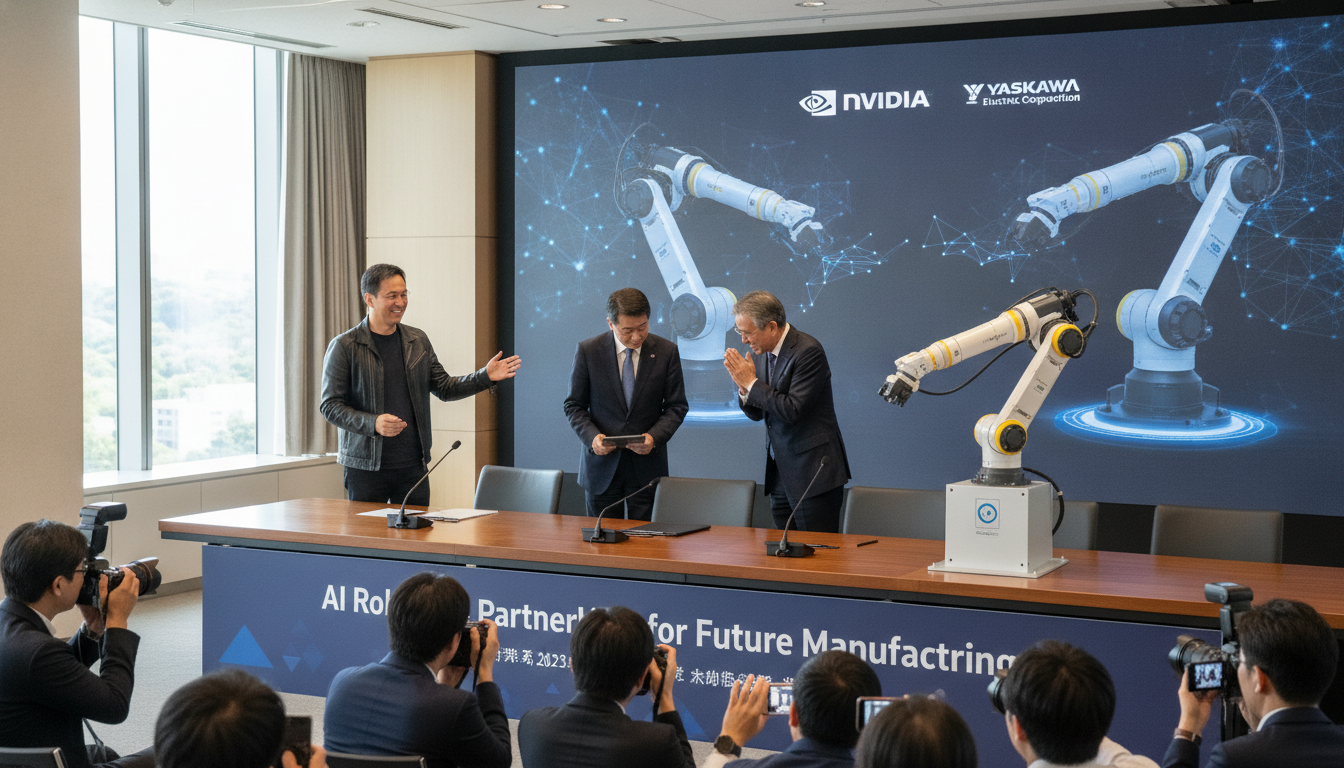
Nvidia to Partner with Fanuc and Yaskawa to Advance Robotics AI in Japan
Nvidia teams with Fanuc and Yaskawa in Japan to develop robotics AI that makes industrial robots adaptive, easy to deploy and production-ready for factories.
Nvidia robotics AI will be developed in collaboration with major Japanese machine builders, the company announced at an event in Tokyo, signaling a new phase in industrial automation. The partnership brings together Nvidia’s GPU and software expertise with Fanuc and Yaskawa’s robotics engineering to create systems intended to be more adaptable and easier to program. The move seeks to accelerate deployment of intelligent robots across factories and service operations in Japan and beyond.
Nvidia Announces Japan Robotics AI Collaboration
Nvidia confirmed the strategic cooperation during a Tokyo event where company leadership emphasized the role of artificial intelligence in making robots more capable. The initiative pairs Nvidia’s compute platforms with Fanuc and Yaskawa’s robot fleets to integrate advanced perception and control. Company representatives described the collaboration as focused on turning research models into practical solutions for live industrial environments.
The announcement frames the effort as an industry-scale attempt to bridge chipmaker innovation and robotics manufacturing know-how. By co-developing software stacks and application toolkits, the partners aim to reduce the technical barriers that currently limit robot flexibility. Observers noted that a close working relationship between silicon vendors and robot makers could shorten the time from lab prototypes to factory deployment.
Scope of Partnerships with Fanuc and Yaskawa
The partnership will target multiple layers of robotics systems, combining Nvidia’s GPUs and AI frameworks with Fanuc’s and Yaskawa’s motion control and hardware expertise. Joint work is expected to cover perception models, task planning, and edge inference pipelines so robots can operate with low latency on the factory floor. The partners plan to focus on reliability and ease of integration to meet industrial safety and productivity requirements.
Collaboration is expected to include software development kits and reference architectures that enable third-party integrators to deploy applications more quickly. This approach is intended to help small and mid-sized manufacturers adopt advanced robotics without custom programming for every task. The companies also signaled an intention to standardize interfaces to allow broader interoperability across robot brands and tooling.
Technical Goals and Expected Capabilities
Engineers will prioritize capabilities that make robots adaptable to variable tasks, such as improved vision, multimodal sensing, and online learning for rapid retraining. The technical roadmap includes real-time perception pipelines for object recognition, pose estimation, and anomaly detection that run on optimized GPU hardware. Another objective is to simplify task specification through higher-level APIs and graphical programming tools that reduce reliance on expert coders.
Safety, deterministic control, and low-latency feedback loops are central to the technical design, reflecting industrial constraints where downtime and errors carry high costs. The partners also intend to explore reinforcement learning and simulation-to-reality transfer techniques to speed up deployment. By combining simulation environments with real-world data, developers hope to produce robust models that generalize across different production lines.
Applications in Manufacturing and Logistics
Primary use cases identified include assembly, machine tending, quality inspection, and parts handling, where adaptive perception can reduce setup time and errors. Improved robotic vision could automate visual inspection tasks that today require human operators, increasing throughput while maintaining quality standards. In logistics and intralogistics, the partners expect AI-enabled robots to handle a broader variety of packages and tasks with less human oversight.
The collaboration also targets collaborative robots that work alongside people on shared tasks, providing more natural human-robot interaction and dynamic task handovers. For service industries, adaptable robots could be applied to tasks such as materials transport, cleaning, or inspection in constrained spaces. The emphasis on ease of deployment aims to expand use beyond large manufacturers to smaller plants where integration costs have been a barrier.
Market and Competitive Implications for Robotics
The alliance strengthens Japan’s position in the global robotics market by combining local robot makers’ market reach with a leading U.S. chipmaker’s AI stack. Analysts say the move could intensify competition with other ecosystems that pair semiconductors and automation, potentially reshaping supply chains for chips and robot controllers. For Nvidia, deeper ties to robotics introduce new demand for specialized GPU modules and software subscriptions tailored to industrial customers.
For Fanuc and Yaskawa, the partnership may fast-track product innovations and broaden their addressable markets, particularly among manufacturers seeking turnkey AI capabilities. Competitors will likely accelerate their own software initiatives, leading to a market where platform ecosystems and developer tools determine hardware adoption. The dynamic may also prompt new service models, including cloud-assisted inference, edge updates, and managed robotics offerings.
Timeline, Pilots, and Commercial Rollout Plans
According to company statements in Tokyo, initial pilots and joint development projects will begin in the near term with deployments focused on controlled factory environments. The partners plan to test integrated systems in real production lines to validate reliability, safety, and performance under operational conditions. Pilot outcomes will inform commercial product offerings and support services that the companies intend to scale regionally.
Companies indicated that commercialization will follow iterative testing, with platforms and toolkits refined based on field feedback. The partners emphasized that measurable improvements in setup time and task flexibility will be key metrics for broader rollout. While precise commercial dates were not provided at the event, executives committed to accelerating deployments to meet customer demand for more capable and easier-to-use robots.
The collaboration between Nvidia, Fanuc and Yaskawa marks a strategic push to make robotics AI more practical for industrial use, combining high-performance compute with decades of robotics engineering. If successful, the effort could lower barriers for widespread automation, reshape supplier relationships, and speed the arrival of adaptable, production-ready robots across manufacturing and services.
